
GROWING GLOBAL STATURE THROUGH INDIA-JAPAN STRATEGIC AXIS: LALIT GARG
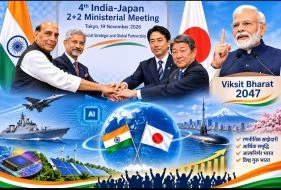
The fourth India-Japan '2+2' Foreign and Defence Ministerial Dialogue, held in Tokyo on November 19, 2026, was not merely a diplomatic meeting between two nations; it served as a powerful indicator of India’s expanding role within the evolving global order. The comprehensive strategic vision articulated by India’s Defence Minister, Shri Rajnath Singh, and External Affairs Minister, Dr. S. Jaishankar—alongside their Japanese counterparts, Foreign Minister Toshimitsu Motegi and Defence Minister Shinjiro Koizumi—has propelled India-Japan relations into new dimensions, encompassing security, technology, maritime cooperation, economic security, and global governance. The most significant takeaway from this dialogue is that India is no longer a mere spectator to the global balance of power, but is emerging as a force that helps shape it. The deepening cooperation with Japan represents a crucial chapter in this transformation. Both nations reaffirmed their commitment to a free, open, inclusiv

GROWING GLOBAL STATURE THROUGH INDIA-JAPAN STRATEGIC AXIS: LALIT GARG
22-NOV-ENG 8


RAJIV NAYAN AGRAWAL
ARA----------------------------The fourth India-Japan '2+2' Foreign and Defence Ministerial Dialogue, held in Tokyo on November 19, 2026, was not merely a diplomatic meeting between two nations; it served as a powerful indicator of India’s expanding role within the evolving global order. The comprehensive strategic vision articulated by India’s Defence Minister, Shri Rajnath Singh, and External Affairs Minister, Dr. S. Jaishankar—alongside their Japanese counterparts, Foreign Minister Toshimitsu Motegi and Defence Minister Shinjiro Koizumi—has propelled India-Japan relations into new dimensions, encompassing security, technology, maritime cooperation, economic security, and global governance. The most significant takeaway from this dialogue is that India is no longer a mere spectator to the global balance of power, but is emerging as a force that helps shape it. The deepening cooperation with Japan represents a crucial chapter in this transformation. Both nations reaffirmed their commitment to a free, open, inclusive, and rules-based Indo-Pacific, while agreeing to advance collaboration in areas such as maritime and aerial surveillance, information sharing, search and rescue operations, cybersecurity, artificial intelligence (AI), and the defence industry. Agreements regarding the use of firing ranges in India by the Japan Self-Defence Forces, as well as the commitment to foster defence-industrial cooperation under the 'Design with Japan, Make in India' initiative, are significant steps toward transitioning this partnership from mere declarations to practical, ground-level implementation.
In this context, the role of Defence Minister Shri Rajnath Singh becomes particularly significant. India’s defence policy is no longer confined to the procurement of weaponry; rather, its objective is to empower the nation in terms of defence production, technology, research, and exports. Recently, the Defence Minister noted that India’s defence production has reached a record high of ₹1.80 lakh crore, while defence exports have climbed to an all-time peak of ₹38,000 crore. Defense-technology and industrial cooperation with Japan can link this pursuit of self-reliance to international technical partnerships. Meanwhile, Dr. S. Jaishankar stands as a key architect of an Indian foreign policy that has transformed the nation—moving it away from being aligned with any single ‘bloc’ and toward becoming an influential power that engages with various global power centers based on its own interests and principles.
Strategic trust with Japan, collaboration within forums like the Quad, a shared commitment to stability in the Indo-Pacific, and mutual support for United Nations Security Council reforms are all integral to this broader diplomatic vision. Both nations have also reiterated their support for each other’s bids for permanent membership in the UN Security Council. However, to fully grasp this picture, one must view it in the context of Prime Minister Narendra Modi’s overarching foreign policy and the vision of a ‘Viksit Bharat’ (Developed India). In the Prime Minister’s foreign policy, security and the economy are not separate domains. Today, India expands its trade with the very nations from which it acquires defense technology. Where it attracts investment, it simultaneously seeks markets for Indian industry; and where it fosters strategic cooperation, it also establishes the reputation of Indian talent, technology, and culture. This represents a new Indian approach—one that bridges foreign policy with economic strength and national prestige.
On November 19, during the centenary celebrations of FICCI in New Delhi, Prime Minister Modi articulated this vision to the industrial sector with great clarity. The FICCI conference, themed ‘India 2047,’ brought together industry leaders, diplomats, policymakers, and global representatives. The Prime Minister urged the industry to ensure that every long-term investment decision over the next 20 years is guided by an ‘India First’ approach. He further emphasized that India’s vast domestic market should not become a ‘comfort zone’ for industry; rather, it should serve as a foundation that fosters the confidence to compete in global markets. It is here that the connection between the ‘2+2’ ministerial dialogue in Tokyo and the platform provided by FICCI becomes strikingly evident. While Rajnath Singh and S. Jaishankar are expanding India’s security reach and diplomatic influence globally, Prime Minister Modi is calling upon Indian industry to enter the global marketplace. In other words, the next phase of India’s foreign policy is not merely about ‘the world for India,’ but about positioning India for the world.
The Prime Minister’s message is not intended solely for industrialists. The government cannot build a ‘developed India’ (Viksit Bharat) on its own. While the government can provide direction and foster an enabling environment, it is the industry that generates economic strength, the youth who drive innovation, and scientists and professionals who foster excellence. Furthermore, India’s reputation is also shaped by the conduct of its ordinary citizens. Therefore, it is essential today for Indian industrialists to move beyond a mindset focused solely on success within India and, instead, establish the identity of Indian brands in global markets. At FICCI, the Prime Minister placed special emphasis on understanding the needs of global consumers, tailoring products to local markets, adopting international standards, and developing robust distribution networks. For Indian industry, this message transcends mere economic policy; it is a national obligation. Similarly, the contribution of every individual citizen is vital. When an Indian performs their duties with integrity, respects the law, safeguards public property, embraces cleanliness and discipline, contributes to enhancing the quality of Indian products, and presents a positive image of India to the world, they—perhaps inadvertently—strengthen India’s ‘soft power.’
Becoming a ‘Vishwa Guru’ (a global leader/guide) does not merely mean offering sermons; rather, it entails sharing one’s conduct, knowledge, technology, economy, culture, and human values with the world. is the industry that generates economic strength, the youth who drive innovation, and scientists and professionals who foster excellence. Furthermore, India’s reputation is also shaped by the conduct of its ordinary citizens. Therefore, it is essential today for Indian industrialists to move beyond a mindset focused solely on success within India and, instead, establish the identity of Indian brands in global markets. At FICCI, the Prime Minister placed special emphasis on understanding the needs of global consumers, tailoring products to local markets, adopting international standards, and developing robust distribution networks. For Indian industry, this message transcends mere economic policy; it is a national obligation. Similarly, the contribution of every individual citizen is vital. When an Indian performs their duties with integrity, respects the law, safeguards public property, embraces cleanliness and discipline, contributes to enhancing the quality of Indian products, and presents a positive image of India to the world, they—perhaps inadvertently—strengthen India’s ‘soft power.’
Becoming a ‘Vishwa Guru’ (a global leader/guide) does not merely mean offering sermons; rather, it entails sharing one’s conduct, knowledge, technology, economy, culture, and human values with the world.
What's Your Reaction?
 Like
0
 Dislike
0
 Love
0
 Funny
0
 Wow
0
 Sad
0
 Angry
0












Comments (0)