
300 YEAR OLD TRADITIONAL SWEET OF BHOJPUR OUTSHINES MODERN CONFECTIONS
-Shahpur in Bihar is known not only for its soil and culture but also for a unique, nearly 300-year-old sweet called 'Jharua'. Although dozens of new varieties of sweets have entered the market in modern times, the traditional taste of Jharua continues to captivate people.

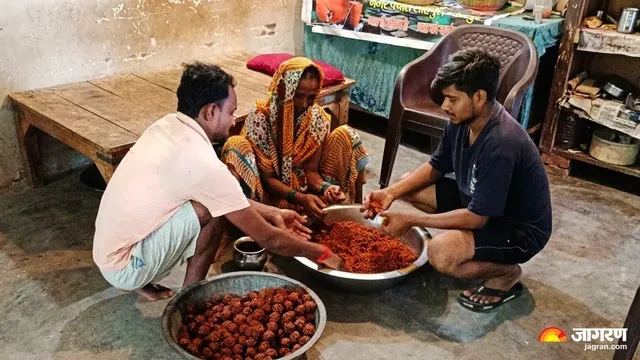
300 YEAR OLD TRADITIONAL SWEET OF BHOJPUR OUTSHINES MODERN CONFECTIONS
3-NOV-ENG 10


RAJIV NAYAN AGRAWAL
ARA-------------------------Shahpur in Bihar is known not only for its soil and culture but also for a unique, nearly 300-year-old sweet called 'Jharua'. Although dozens of new varieties of sweets have entered the market in modern times, the traditional taste of Jharua continues to captivate people.
Demand for this sweet surges significantly, especially during the period from Diwali to Chhath Puja. During the festive season—spanning about a week—sales of Jharua reach 70 to 80 quintals. This generates business worth lakhs of rupees and supports the livelihoods of hundreds of local families.
Festivals such as Dhanteras, Diwali, Govardhan Puja, Bhaiya Dooj, and Chhath are the most significant occasions for the artisans and traders who produce Jharua.
As festivals approach, production ramps up. Artisans work tirelessly, day and night, to meet the demand. Approximately 30 to 40 quintals of Jharua are sold during Govardhan Puja and Bhaiya Dooj alone, with sales continuing through Diwali and Chhath. The most notable feature of jharua is its authentic, traditional flavor and the traditional method used to prepare it. It consists of small [pieces] made from chickpea flour (besan) It is made using tiny droplets of batter (*boondis*).
These droplets are deep-fried in *ghee* or *dalda* (hydrogenated vegetable fat) and then mixed into a syrup made from traditional jaggery (*desi gud*). The natural sweetness of the jaggery combined with the flavor of the gram flour (*besan*) gives *Jharua* a distinct identity, setting it apart from other sweets. It is this traditional taste that continues to draw people toward *Jharua*, even amidst the array of modern-day confections.
*Jharua* is not merely consumed as a sweet; it holds special significance during religious rituals and festivals. Because it has a long shelf life, people often purchase it well in advance to keep at home.
It is in high demand for various occasions—from *Diwali* *puja* and *Govardhan Puja* to being offered as *prasad* during the festival of *Chhath*. People also prefer it as a gift for relatives and guests.
The tradition of making *Jharua* in Shahpur is said to date back over three hundred years. According to local traders, about half a dozen families are currently involved in the production of this traditional sweet.
The families of Santosh Sah, Tula Sah, and Shribhagwan Sah are among those who have been engaged in this craft for a long time. While these families produce *Jharua* throughout the year, production increases manifold during the festive season.
The high demand for *Jharua* during the festive season is evident from the fact that a single family can produce as much as three to four quintals per day.
Beyond the various markets in Shahpur, it is also supplied to surrounding areas. Currently, the standard price for *Jharua* is approximately 120 to 130 rupees per kilogram. There is also occasional demand for premium-quality *Jharua*.
*Jharua* is not just a source of income for the families who make it; hundreds of shopkeepers are also involved in its sale. The surge in demand during festivals creates additional employment opportunities not only for the artisans but also for shopkeepers and other small-scale traders. In this way, this 300-year-old sweet has become an important part of the local economy today.
The popularity of Shahpur’s ‘Jharua’ is not limited to the general public. According to locals, prominent politicians—such as RJD supremo Lalu Prasad Yadav, Shivanand Tiwari, and Professor K.K. Tiwari—have also been fans of its taste.
Jharua also holds a special place in religious events. It is said that it is even distributed as ‘prasad’ (a sacred offering) during events like ‘Mahayajna’ and ‘Gyanyajna,’ held under the guidance of Lakshmi Prapanna Jeeyar Swami.
Although a wide variety of colorful sweets are available in the market today, Jharua has managed to maintain a distinct identity of its own. Its uniqueness lies not just in its taste, but in the centuries-old tradition associated with it.
For the people of Shahpur, purchasing Jharua during festivals is, in a sense, a way of preserving and carrying forward their culture and heritage. This is precisely why this 300-year-old delicacy remains a popular choice even today.
Today, Shahpur’s Jharua has transcended the status of a mere sweet. It weaves together local culture, tradition, and livelihoods.
The surge in demand for it during the period from Diwali to Chhath serves as proof that the true strength of traditional offerings lies in their taste and the sentiments attached to them.
The 300-year-old tradition of Jharua continues to reach new generations, adding a touch of sweetness to the identity of Shahpur.
What's Your Reaction?
 Like
0
 Dislike
0
 Love
0
 Funny
0
 Wow
0
 Sad
0
 Angry
0







Comments (0)