
UPROAR OVER SONIA GANDHI’S AUTOBIOGRAPHY
“Books want to say something; they want to stay with you…” These lines from a poem by Safdar Hashmi once lived on the tongues of the literate across the country. Without dwelling on the painful circumstances of Safdar’s death, the lines come to mind now because Sonia Gandhi’s book has arrived — and the habitual fault-finders of political grief have begun raising every kind of noise. One feels genuine pity for them. If books wish to speak to you and you do not wish to listen, do not listen. If they wish to remain with you and you prefer to keep them at a distance, keep them at a distance by all means. But why must people pick up a pickaxe and leave home demanding to know why this was not written and why that was written?

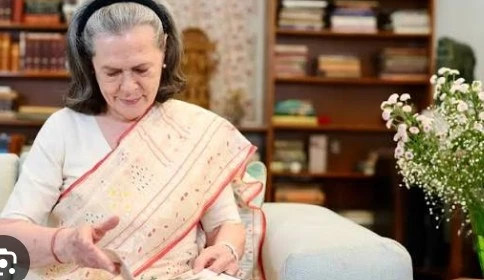
UPROAR OVER SONIA GANDHI’S AUTOBIOGRAPHY
16-NOV-ENG 1


RAJIV NAYAN AGRAWAL
DELHI--------------------------“Books want to say something; they want to stay with you…” These lines from a poem by Safdar Hashmi once lived on the tongues of the literate across the country. Without dwelling on the painful circumstances of Safdar’s death, the lines come to mind now because Sonia Gandhi’s book has arrived — and the habitual fault-finders of political grief have begun raising every kind of noise. One feels genuine pity for them. If books wish to speak to you and you do not wish to listen, do not listen. If they wish to remain with you and you prefer to keep them at a distance, keep them at a distance by all means. But why must people pick up a pickaxe and leave home demanding to know why this was not written and why that was written?
It is difficult to recall any other political autobiography, anywhere in the world, that has provoked such petty political uproar from a rival party or from the ideological followers of any school of thought. From the senior figures of the Bharatiya Janata Party and the Rashtriya Swayamsevak Sangh down to their organic and inorganic small-timers, an extraordinary din has been raised over Sonia Gandhi’s book, as if Mount Sumeru itself had collapsed upon them.
Memoir writing is not unknown to the BJP-Sangh world. Many of its pen-wielders have produced such works. Was any of them ever subjected to this kind of personal vilification? Narendra Damodardas Modi has not yet set down his memories on the page. But did ideological opponents ever launch personal attacks on Vinayak Damodar Savarkar’s My Transportation for Life? The major leaders of the Jana Sangh — Deendayal Upadhyaya and Syama Prasad Mookerjee — never wrote formal autobiographies. Theoretical debate continues over books such as Upadhyaya’s Integral Humanism and Why Akhand Bharat, yet no one has used those works as a pretext for personal condemnation. After Mookerjee’s death, pages from his private diary were published as Leaves from a Diary. No one turned that into an occasion for personal criticism.
Atal Bihari Vajpayee, the most popular and influential leader the Jana Sangh and BJP have known, never wrote a formal autobiography either. Yet collections of his speeches and magazine articles appeared regularly — The Slippery Paths of Politics, My Parliamentary Journey, Neither Destitution nor Flight, The Politics of Coalitions. Does anyone remember any sustained lament that he should not have written this or that he should have written that?
Lal Krishna Advani wrote about the Emergency, the Ram Rath Yatra and successive central governments in My Country, My Life, mixing fact and interpretation as authors do. The opposition raised no hue and cry. Jaswant Singh, in A Call to Honour, presented the Kargil war and the Kandahar episode with his own emphases; the opposition did not create a storm. Shanta Kumar recorded several things in his autobiography that the opposition could easily have exploited; it chose not to. Ram Naik floated any number of balloons in Charaiveti! Charaiveti!; no one thought it necessary to burst them all. From Kalraj Mishra to Tathagata Roy, books by leaders of the same political family met only silence from the other side. Vijayaraje Scindia, with the help of Manohar Malgonkar, gave her preferred account of the Emergency years; Congress could have picked those pages apart thread by thread, yet no personal campaign was mounted against her.
Balraj Madhok wrote things against Atal Bihari Vajpayee that the opposition could have used for daily denunciation; no one crossed the bounds of restraint. Dattopant Thengadi, M.G. Vaidya, Moropant Pingle and Laxmanrao Inamdar may not have written autobiographies, but many of their books could have been thrown into the pool of controversy. No one did so. N. Govindacharya and Seshadri Chari published memoir-style pieces that later appeared as books; the opposing camp never made them targets of personal abuse.
The top leadership of the RSS has never cultivated the tradition of writing autobiography. The usual justification is that the individual is unimportant; what matters is the idea and the organisation. If recording personal achievements feels improper, so be it. But in a century-long journey, has the organisation never committed any error? Could those not be mentioned, and could the steps taken to correct them not be shared with the country? Keshav Baliram Hedgewar and Madhav Sadashiv Golwalkar left no autobiographies, yet collections of speeches by Madhukar Dattatreya Deoras, Rajendra Singh and K.S. Sudarshan have been published. Balasaheb Deoras shared reminiscences with colleagues that later appeared in book form. Rajju Bhaiya recorded his memories on audio; on the basis of those recordings our friend Ratan Sharda wrote The Life and Times of Rajju Bhaiya. No one picked nits.
Yet the moment Sonia Gandhi’s autobiography appeared, the ruling camp erupted. People who ought to know better have begun saying things that openly violate every standard of civility. Her personal life is being splashed with mud. Passages that offer political assessment are being rejected with contempt. The frankness, the absence of rancour and the detachment that mark the book are being denied, and a deliberate effort is under way to paint Sonia Gandhi as a schemer.
This is unfortunate. Yet the reaction from the corridors of power is, in its own way, natural. Sonia Gandhi’s autobiography has already begun to find a place among the enduring works of the genre worldwide. It is being spoken of as one of the more remarkable life stories written so far. That Belonging should be a bestseller at every counter is almost a matter of course. Whether the story is told with such purity by Anne Frank or Maya Angelou, by Nelson Mandela or Frederick Douglass, by Benjamin Franklin or Barack Obama, by Mahatma Gandhi or Sonia Gandhi, sales records tend to fall. The real point is that such books come to occupy a place in the hearts of society at large. And whenever that happens, the pillars of political power begin to feel a tremor. The artificial black rain now being arranged over Sonia Gandhi’s book has its origin there.
What's Your Reaction?
 Like
0
 Dislike
0
 Love
0
 Funny
0
 Wow
0
 Sad
0
 Angry
0




Comments (0)