
CHALLENGE OF SUFFOCATING BREATH AMIDST RISING POLLUTION IN A WARMING WORLD: LALIT GARG
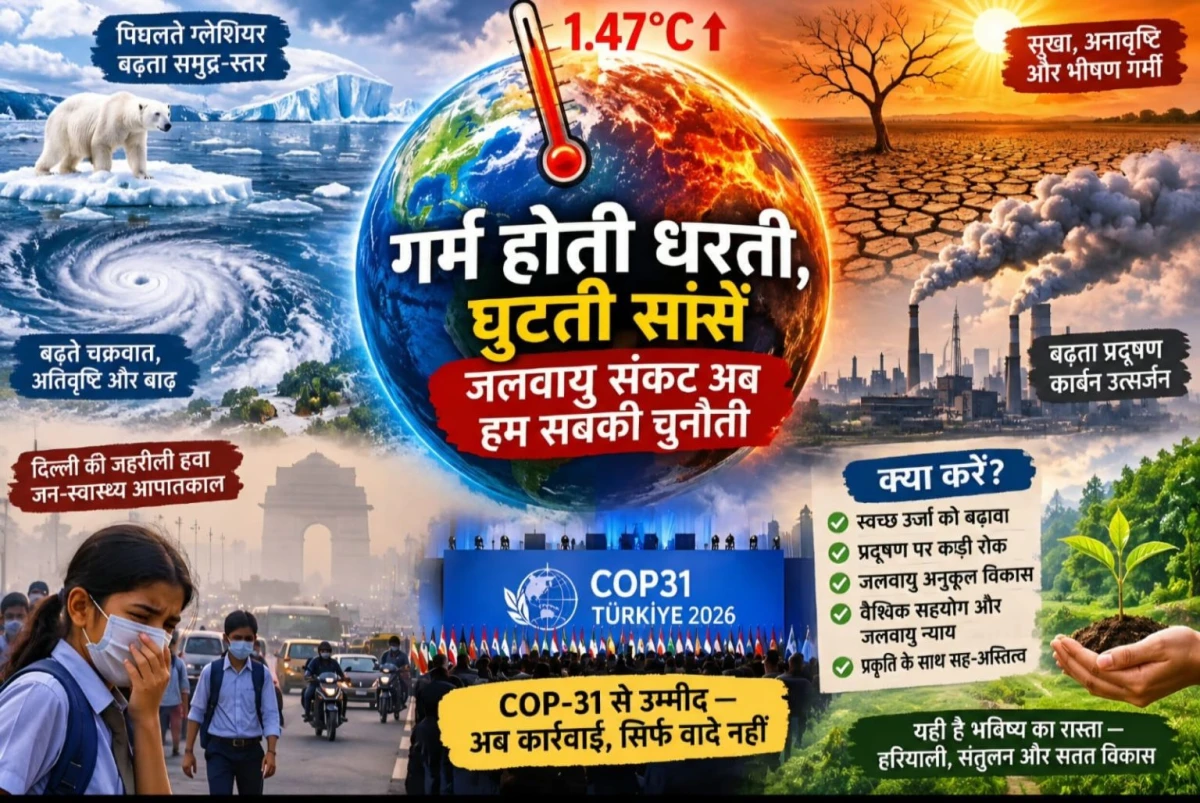
-Today, the entire world is confronting the harsh reality of climate change—a phenomenon once dismissed as a mere future possibility. Extreme rainfall, prolonged dry spells, droughts, floods, cyclones, forest fires, rising sea levels, and abnormal heat are no longer rare or extraordinary occurrences. The rapid deterioration of nature’s balance has posed a grave existential question for human civilization. The 'State of the Climate Update 2026' report, released by the World Meteorological Organization (WMO) on November 9, 2026, highlights the severity of this crisis through scientific data. According to the report, 2026 is on track to be among the four hottest years ever recorded; from January to September, the global average temperature was approximately 1.47°C higher than the pre-industrial average (1850–1900). In fact, every year from 2015 to 2026 has ranked among the hottest on record. These figures represent more than just a rise in temperature—they signal an escalating crisis for

CHALLENGE OF SUFFOCATING BREATH AMIDST RISING POLLUTION IN A WARMING WORLD: LALIT GARG


13-NOV-ENG 3


RAJIV NAYAN AGRAWAL
ARA----------------------------Today, the entire world is confronting the harsh reality of climate change—a phenomenon once dismissed as a mere future possibility. Extreme rainfall, prolonged dry spells, droughts, floods, cyclones, forest fires, rising sea levels, and abnormal heat are no longer rare or extraordinary occurrences. The rapid deterioration of nature’s balance has posed a grave existential question for human civilization. The 'State of the Climate Update 2026' report, released by the World Meteorological Organization (WMO) on November 9, 2026, highlights the severity of this crisis through scientific data. According to the report, 2026 is on track to be among the four hottest years ever recorded; from January to September, the global average temperature was approximately 1.47°C higher than the pre-industrial average (1850–1900). In fact, every year from 2015 to 2026 has ranked among the hottest on record. These figures represent more than just a rise in temperature—they signal an escalating crisis for human life. The accumulation of excess heat in the oceans, melting glaciers, rising sea levels, increasing pollution, and shifting precipitation patterns all point toward the formidable challenges that lie ahead. According to the WMO, the world’s oceans have reached record temperatures for the tenth consecutive year, and global sea levels also hit a record high in 2026.
The situation this year is particularly concerning due to the development of a strong El Niño. The WMO notes that the El Niño phenomenon has intensified rapidly since August, and its strength could reach an extraordinary level between November 2026 and January 2027. This could heighten the risk of extreme weather events—such as intense heatwaves, droughts, and heavy rainfall—throughout 2027. In other words, the danger is not limited to the present; the coming year could also force humanity to confront the harsher side of nature. Consequently, it would be a grave error to view climate change merely as a matter for environment ministries or international conferences. It has evolved into an issue deeply intertwined with health, the economy, food security, employment, water resources, housing, and social stability. The greatest irony of the climate crisis is that its heaviest burden falls upon countries and communities whose historical carbon emissions have been relatively low. Developing and impoverished nations face a dual challenge: meeting their development needs while simultaneously safeguarding themselves against the climate crisis.
For decades, developed nations relied heavily on fossil fuels to drive their industrial growth. Yet, today, as developing countries strive for economic progress, they are expected to curb their emissions. This is why the question of 'climate justice' is of paramount importance. If the global community truly seeks a solution, it must provide developing nations with substantial financial and technical support for clean energy, green technology, climate adaptation, and disaster-resilient infrastructure. In this context, the ongoing COP-31 in Antalya, Türkiye, holds great significance. Taking place from November 9 to 20, 2026, the conference aims to implement climate solutions and accelerate the global energy transition. The question remains: will the world move beyond mere declarations toward concrete, meaningful action this time?
While many past climate summits have set ambitious goals, the pace of actual implementation has remained sluggish. The need today is not to increase the number of new pledges, but to translate existing commitments into tangible reality. Developed nations must take their financial obligations seriously and ensure that developing countries have access to the necessary technology and resources. Reliance on fossil fuels must be reduced, while the adoption of solar, wind, hydroelectric, and other clean energy sources must be rapidly scaled up. Every sector—from urban planning, public transport, and construction to agriculture and industry—must be made climate-resilient. The question is no longer whether or not climate change is happening. The question is how quickly and how sincerely we confront it.
In the Indian context, the situation is even more critical. On one hand, the country is grappling with rising temperatures, erratic monsoons, floods, and droughts; on the other, air pollution in major metropolitan areas has deepened a public health crisis. The alarming levels of pollution witnessed in the Delhi-NCR region around Diwali have made it clear that air—the very foundation of life—has now also become a major health hazard. People suffer from eye irritation, sore throats, breathing difficulties, coughing, and other respiratory ailments, placing an increasing burden on hospitals and medical professionals. This cannot be dismissed as a mere seasonal inconvenience. Air pollution and climate change are not separate crises; the excessive use of fossil fuels exacerbates both. Thus, there is a profound link between the toxic air in Delhi and the rising global temperatures.
During the COVID-19 pandemic, India faced an unprecedented health emergency. At that time, the administration, the healthcare system, civil society, and the general public joined forces to tackle the crisis. Today, a similar level of seriousness is required to address air pollution. This does not merely mean formally declaring an emergency, but rather formulating an emergency action plan centered on public health. In the Delhi-NCR region, immediate and coordinated action is essential regarding schools, construction activities, traffic, industrial emissions, and the burning of crop stubble and waste. It is imperative to ensure hospital preparedness, provide health advisories for vulnerable populations, strengthen public transport, and implement effective control measures at the sources of pollution. The Government of India, in collaboration with the states We must work together to establish a permanent framework in which pollution is not viewed merely as a winter-specific problem. This requires year-round air quality monitoring, emission controls, and scientific assessment of health impacts.
India possesses the potential not only to offer the world technical solutions but also to provide a vision for life. Centuries ago, Indian culture recognized nature not as an object for consumption, but as a companion in life. The Jain philosophical principles of *ahimsa* (non-violence) and *aparigraha* (non-possessiveness) are highly relevant in today’s era of climate crisis. We must shift away from a mindset characterized by excessive consumption, indiscriminate exploitation of resources, and the desire to dominate nature. We need to move beyond the perception that development and the environment are inherently in conflict. We require a model of development that generates employment and drives the economy, without destroying our air, water, soil, and forests. This is true sustainable development.
As we look toward COP-31, the world does not need another declaration; it requires firm political will, financial commitment, and time-bound action. In the face of a climate crisis, inaction is also a choice—one for which future generations will pay the price. The Earth is sounding an alarm: temperatures are rising, oceans are warming, ice is melting, and the air in our cities is becoming toxic. There is still time for humanity to rethink its vision of development. The path forward lies not in conflict with nature, but in coexistence. If we do not wake up today, future generations will surely ask: when the danger was clearly visible, why did the world take so long to act?
What's Your Reaction?
 Like
0
 Dislike
0
 Love
0
 Funny
0
 Wow
0
 Sad
0
 Angry
0















Comments (0)