
SACRED CONNECTION BETWEEN CHHATHI MAIYA AND LORD KARTIKEYA
Every autumn, millions of devotees across Bihar, Jharkhand, Uttar Pradesh, and the global Purvanchali diaspora gather along riverbanks and sacred ponds to celebrate Chhath Mahaparv—one of the most rigorous, ancient, and spiritually resonant festivals in Sanatan Dharma. While the four-day festival is universally recognized as a thanksgiving to Surya Dev (the Sun God) for sustaining life on Earth, its deeper scriptural roots reveal an extraordinary mythological connection to Goddess Shashti—revered affectionately as Chhathi Maiya—and Lord Kartikeya, the eldest son of Lord Shiva and Goddess Parvati.

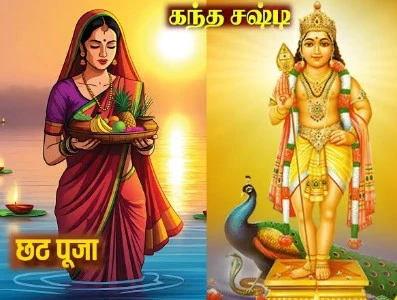
SACRED CONNECTION BETWEEN CHHATHI MAIYA AND LORD KARTIKEYA
15-NOV-ENG 4


RAJIV NAYAN AGRAWAL
ARA----------------------------Every autumn, millions of devotees across Bihar, Jharkhand, Uttar Pradesh, and the global Purvanchali diaspora gather along riverbanks and sacred ponds to celebrate Chhath Mahaparv—one of the most rigorous, ancient, and spiritually resonant festivals in Sanatan Dharma. While the four-day festival is universally recognized as a thanksgiving to Surya Dev (the Sun God) for sustaining life on Earth, its deeper scriptural roots reveal an extraordinary mythological connection to Goddess Shashti—revered affectionately as Chhathi Maiya—and Lord Kartikeya, the eldest son of Lord Shiva and Goddess Parvati.
According to authoritative Hindu scriptures, including the Brahma Vaivarta Purana and the Devi Bhagavata Purana, Chhathi Maiya is identified as Goddess Shashti, the sixth form of Prakriti (primordial nature). In Puranic lore, she is also revered as Devasena, the celestial commander of the divine armies and the daughter of Lord Indra, the king of the Devas.
Following Lord Kartikeya’s triumphant victory over the demon Tarakasura, Indra offered Devasena’s hand in marriage to Kartikeya to restore cosmic balance and dharma. As Kartikeya’s divine consort, Goddess Devasena became known in folk tradition and Prakrit dialects as Shashti or Chhathi Maiya. In regional cultural traditions across Purvanchal and Mithila, she is also regarded as the manas (spiritual) sister of Surya Dev, explaining why both the Sun God and Chhathi Maiya are jointly worshipped during the sacred Arghya offerings at dusk and dawn.
Sacred texts trace the earthly observance of the Chhath fast to King Priyavrata, the son of Svayambhuva Manu. Despite possessing immense wealth and a prosperous kingdom, Priyavrata was consumed by grief because he had no heir. On the advice of Maharishi Kashyapa, the king performed a grand Putrakameshti Yajna.
Although his queen, Malini, eventually conceived, the child was stillborn. Devastated, King Priyavrata carried the lifeless infant to the cremation ground and prepared to end his own life out of despair. At that critical moment, Goddess Devasena (Shashti Devi) manifested from the skies in a radiant celestial chariot. Introducing herself as the mind-born daughter of Lord Brahma and the consort of Lord Kartikeya, she touched the infant with her divine hands, instantly restoring the child to life and robust health.
Overwhelmed with gratitude, King Priyavrata asked how he could repay her grace. Goddess Shashti instructed the monarch to propagate her worship across the mortal realm so that parents and families could be blessed with healthy progeny, longevity, and prosperity. Following her command, King Priyavrata observed a strict fast and performed ritual worship on the sixth day (Shashti) of the bright fortnight (Shukla Paksha) in the Hindu month of Kartik—establishing the enduring tradition of Chhath Puja.
In Ayurveda and classical Sanskrit literature, Goddess Shashti is revered as the presiding deity of childbirth and the guardian of newborn infants, protecting children from ailments during the vulnerable post-natal period (sutika griha).
Interestingly, the mythology surrounding Chhathi Maiya and Lord Kartikeya also bridges a fascinating cultural contrast between North and South India:
Based on narratives from the Shiva Purana, North Indian folklore largely views Lord Kartikeya as a lifelong celibate (Bal Brahmachari) who retreated to Mount Krouncha after Lord Ganesha was married first. Consequently, his marital bond with Devasena is less emphasized in popular northern temple worship, even though millions unknowingly bow to his consort every year during Chhath.
Conversely, in South India—where Kartikeya is widely worshipped as Lord Murugan or Subramanya—his role as a householder is celebrated extensively. According to the Skanda Purana, his marriage to Devasena earned him the title Devasenapati. Spiritually, Lord Kartikeya embodies Jnana Shakti (supreme knowledge), while Devasena represents Kriya Shakti (active energy) and his second consort, Valli, symbolizes Iccha Shakti (willpower).
Ultimately, Chhath Mahaparv stands as a profound synthesis of Vedic nature worship and Puranic devotion. By honoring Surya Dev—the visible source of cosmic energy—alongside Chhathi Maiya, the divine mother who nurtures and protects life, devotees celebrate purity, environmental harmony, and gratitude, keeping an unbroken scriptural legacy alive across generations.
What's Your Reaction?
 Like
0
 Dislike
0
 Love
0
 Funny
0
 Wow
0
 Sad
0
 Angry
0











Comments (0)