
INDIA’S GROWING INFLUENCE AND THE RESONANCE OF MODI’S DIPLOMACY: LALIT GARG
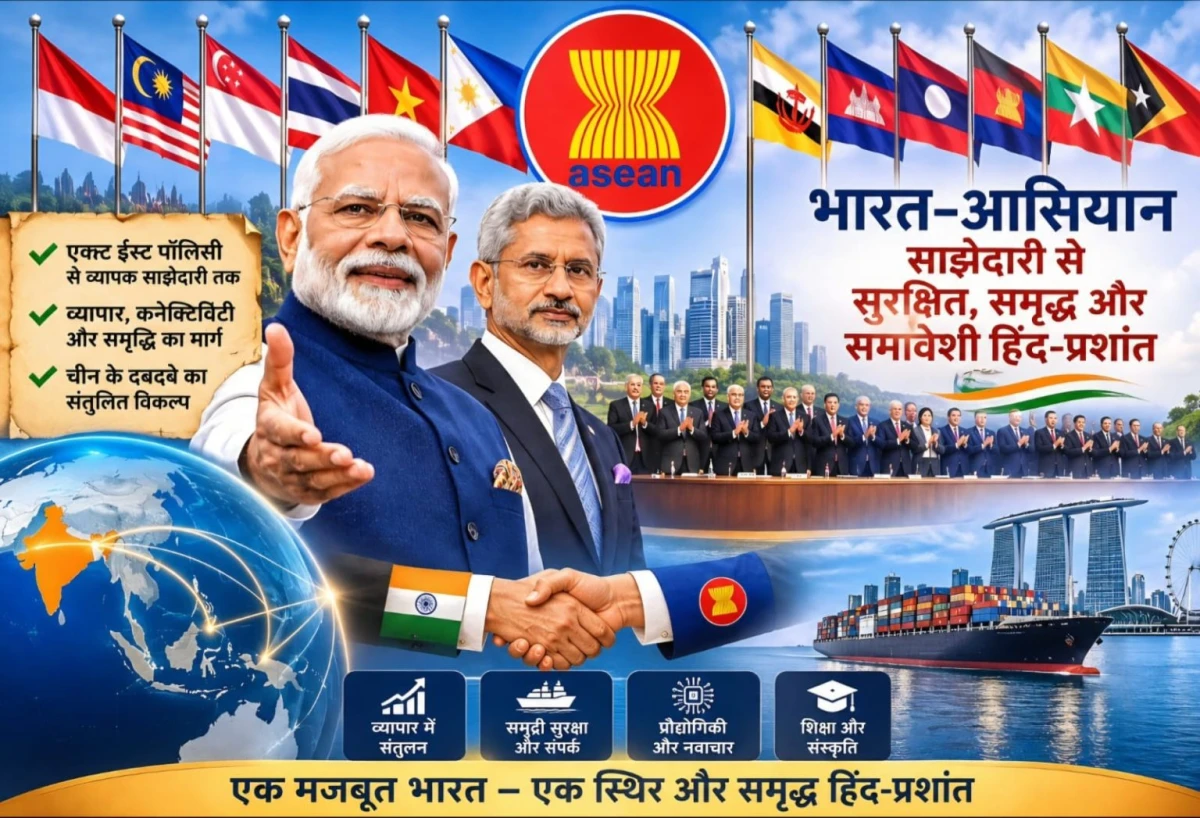
A nation’s global influence is not determined solely by its economic strength, military capability, or population; rather, it is also defined by how seriously the world’s major powers take its voice. India is currently undergoing such a transformation. Although India is not a member of the Association of Southeast Asian Nations (ASEAN)—a bloc comprising 11 countries—the respect and high expectations with which it is welcomed at their summits serve as a significant indicator of India’s evolving global role. The active participation of Prime Minister Narendra Modi in the recent 23rd India-ASEAN Summit and the 21st East Asia Summit, held in Manila (the capital of the Philippines), has further underscored this shifting landscape. It is highly significant that, despite India not being an ASEAN member, it has become increasingly difficult to envision regional dynamics without including India in discussions regarding the bloc’s future. This represents one of the greatest achievements of India

INDIA’S GROWING INFLUENCE AND THE RESONANCE OF MODI’S DIPLOMACY: LALIT GARG


20-NOV-ENG 14
RAJIV NAYAN AGRAWAL
ARA--------------------------A nation’s global influence is not determined solely by its economic strength, military capability, or population; rather, it is also defined by how seriously the world’s major powers take its voice. India is currently undergoing such a transformation. Although India is not a member of the Association of Southeast Asian Nations (ASEAN)—a bloc comprising 11 countries—the respect and high expectations with which it is welcomed at their summits serve as a significant indicator of India’s evolving global role. The active participation of Prime Minister Narendra Modi in the recent 23rd India-ASEAN Summit and the 21st East Asia Summit, held in Manila (the capital of the Philippines), has further underscored this shifting landscape. It is highly significant that, despite India not being an ASEAN member, it has become increasingly difficult to envision regional dynamics without including India in discussions regarding the bloc’s future. This represents one of the greatest achievements of India’s diplomatic journey—a trajectory that began with the ‘Look East’ policy in 1991, evolved into the ‘Act East’ policy in 2014, and has now expanded to encompass a comprehensive vision for the Indo-Pacific. Prime Minister Modi himself has positioned ASEAN at the very heart of India’s ‘Act East’ policy and its Indo-Pacific outlook.
ASEAN is more than just a geographical grouping; it serves as a vital hub for economic power, maritime trade routes, global supply chains, and the strategic politics of the Indo-Pacific. Nations such as Indonesia, Malaysia, Singapore, Thailand, Vietnam, the Philippines, Brunei, Cambodia, Laos, Myanmar, and Timor-Leste are of immense importance to India—spanning areas such as trade, investment, maritime security, technology, and cultural engagement. In Manila, Prime Minister Modi emphasized that India and ASEAN should foster an environment of peace, stability, and development based on cooperation rather than competition. He reiterated India’s commitment to a free, open, inclusive, and rules-based Indo-Pacific, and underscored the importance India places on ASEAN’s unity and centrality. This is not merely diplomatic rhetoric; it reflects India’s long-term strategy—envisioning an Indo-Pacific free from the hegemony of any single power, where smaller nations have the space to pursue independent foreign policies, and maritime routes remain open.
A distinctive feature of Prime Minister Modi’s foreign policy is his effort to position India not just as a ‘large market’ or an ‘emerging economy,’ but as a reliable strategic partner. This was evident in the various bilateral meetings held in Manila. With Philippine President Ferdinand Marcos Jr., Prime Minister Modi discussed progress in cooperation across sectors such as defense, space, railways, financial technology, trade, and investment. Discussions with Singaporean Prime Minister Lawrence Wong covered the digital sphere, skill development, connectivity, healthcare, defense and security, and economic cooperation. With Thai Prime Minister Anutin Charnvirakul, the focus was on advancing ties in trade, investment, defense, security, connectivity, digital technology, and culture. The message behind Modi’s foreign policy is clear: India does not wish to be a mere spectator in international relations; rather, it seeks to be an active architect of a new framework for such relations.
The role of External Affairs Minister Dr. S. Jaishankar throughout this visit cannot be overlooked. He has played a pivotal role in translating the Prime Minister’s political vision into concrete outcomes within the global diplomatic discourse. Far from being merely an administrator of the Ministry of External Affairs, Jaishankar has emerged as a strategic thinker—one who grasps the nuances of a shifting global order—and has become an effective face of India’s foreign policy. India’s foreign policy today demonstrates an ability to maintain a balanced set of relationships with the United States, Russia, Europe, West Asia, Japan, Australia, and the ASEAN nations simultaneously. Rather than aligning with any single bloc, this balance reflects a policy of shaping relations based on India’s own national interests. A core tenet of External Affairs Minister S. Jaishankar’s diplomacy is that India will engage with the world not under the pressure of any external power, but based on its own interests and civilizational vision. The combination of the Prime Minister’s political engagement and the External Affairs Minister’s strategic diplomacy is making India’s foreign policy increasingly impactful.
The presence of U.S. President Donald Trump and Prime Minister Modi at the Manila summit lent particular significance to this visit. On November 17, the first-ever summit-level dialogue of the 'Quad' leaders took place in Manila, involving Modi, Trump, Japan’s Prime Minister Takaichi Sanae, and Australia’s Prime Minister Anthony Albanese. The implications of this development are far-reaching. While strengthening its ties with ASEAN, India is simultaneously reinforcing the strategic architecture of the Indo-Pacific through the Quad—alongside the U.S., Japan, and Australia. This is not about forming a bloc against any specific nation; rather, it is about fostering partnerships in areas such as regional stability, supply chains, critical minerals, maritime security, and technological cooperation. Here, a new dimension of Modi’s foreign policy emerges: India no longer seeks to be a passive participant in the global balance of power, but rather a central player capable of shaping it.
For the ASEAN nations, China is a major economic partner, yet they also face maritime and strategic disputes with it. Amidst tensions in the South China Sea, economic dependencies, and competition for regional influence, these nations are wary of becoming overly reliant on any single power. This presents a significant opportunity for India. India must Rather than rushing to become an alternative to China, India should focus on becoming a credible alternative. This requires reducing the trade deficit, enhancing the quality of Indian products, increasing participation in supply chains, encouraging investment, and accelerating India-ASEAN connectivity projects. Initiatives announced in Manila—such as those concerning maritime cooperation, cyber training, space collaboration, critical minerals, nuclear energy, youth and start-up engagement, and scholarships for students from ASEAN nations at Nalanda—point toward this new direction.
The greatest challenge in India-ASEAN relations is the trade imbalance. Merely increasing imports or opening up markets will not suffice; Indian industry must establish a more aggressive, high-quality, and competitive presence within ASEAN markets. In this context, a review of the Free Trade Agreement is also essential. India’s strength lies not only in its economy but also in its culture. From the traditions of the Ramayana and Buddhist philosophy to Indian languages, Yoga, Ayurveda, and ancient legacies of maritime trade, India and Southeast Asia share a centuries-old bond. The need today is to integrate this civilizational capital with modern economic and technological partnerships. The most significant takeaway from the Manila summit is that India should not view ASEAN merely as an entity within its foreign policy; rather, it should be seen as a gateway for India’s economic, strategic, and civilizational reconnection. If India combines trade, technology, maritime security, and connectivity with culture, education, and youth engagement, then ASEAN will cease to be just a market for India—it could become a natural partner in India’s Indo-Pacific future. The confidence with which Prime Minister Modi presents India’s position on global platforms today is the result of years of diplomatic effort, institutional preparation, and the sustained, proactive engagement of the Ministry of External Affairs. India’s growing acceptance within ASEAN serves as proof that India’s voice is not merely heard—it is also heeded. The next objective of India’s foreign policy should not merely be to establish its presence on the global stage; rather, the goal should be for India to play a decisive role in shaping the world’s key systems. The ASEAN forum in Manila reflects this evolving India—it is no longer a nation merely knocking at the world’s door, but is instead emerging as a power with whom the world seeks to deliberate on its future strategy. This represents the greatest achievement of the foreign policy of the ‘Modi era’ and holds the most significant promise for the India of the future.
What's Your Reaction?
 Like
0
 Dislike
0
 Love
0
 Funny
0
 Wow
0
 Sad
0
 Angry
0








Comments (0)