
GOLD LOOTED FROM RUNNING TRAIN, THREE ARRESTED
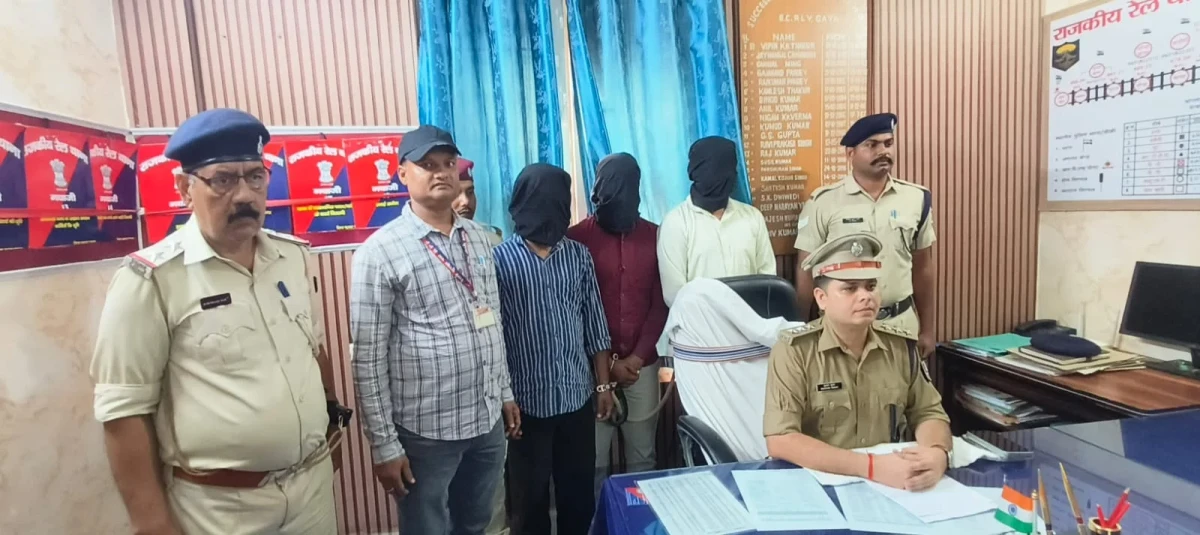
-In a daring robbery that highlights the vulnerabilities of high-value cargo transport on Indian Railways, a gang posing as officials looted gold worth nearly Rs 2.93 crore from a company employee at Bhabhua Road railway station in Kaimur district of Bihar. The incident, which occurred on 24 October 2026, has been cracked by a Special Investigation Team of the railway police, leading to the arrest of three suspects from different districts of Uttar Pradesh. Police have recovered 612.74 grams of gold valued at over Rs 87 lakh along with four mobile phones from the accused.

GOLD LOOTED FROM RUNNING TRAIN, THREE ARRESTED
2-NOV-ENG 2


RAJIV NAYAN AGRAWAL
BHABHUA-------------------------In a daring robbery that highlights the vulnerabilities of high-value cargo transport on Indian Railways, a gang posing as officials looted gold worth nearly Rs 2.93 crore from a company employee at Bhabhua Road railway station in Kaimur district of Bihar. The incident, which occurred on 24 October 2026, has been cracked by a Special Investigation Team of the railway police, leading to the arrest of three suspects from different districts of Uttar Pradesh. Police have recovered 612.74 grams of gold valued at over Rs 87 lakh along with four mobile phones from the accused.
The case has drawn attention not only for the sheer value of the consignment but also for the sophisticated manner in which the robbery was executed in broad daylight at a railway station, with the perpetrators using intimidation and false authority to overpower the victim without immediate violence.
According to police records and the complaint filed by the victim’s side, Sanjeev Chauhan, a 24-year-old employee of Sankalp Gold Private Limited, a firm based in Bareilly, Uttar Pradesh, was travelling with approximately 2.06 kilograms of gold. The gold belonged to the firm’s proprietor, Sanjay Kumar Khandelwal. Chauhan had been sent to Kolkata on official work and was returning to Bareilly with the precious metal on the Chambal Express.
On 24 October 2026, as the train halted at Bhabhua Road railway station in Kaimur, two unidentified men approached Chauhan. Identifying themselves as officials, they stopped him, seized the gold, and also took his mobile phone. The men then issued a series of threats: they warned him against fleeing, threatened to send him to jail, and claimed they would conduct raids at the residence of the gold’s owner. After intimidating the employee into silence and compliance, the duo fled the station with the consignment.
The total value of the looted gold has been calculated at Rs 2,92,87,600. The recovery of only a portion of the metal so far indicates that the remaining gold is either still with other members of the gang or has already been disposed of through informal channels.
Following a written complaint from the victim’s side, an FIR was registered at the Bhabhua Railway Police Station as Case Number 31/26 dated 24 October 2026. The case was registered under relevant sections of the Bharatiya Nyaya Sanhita (BNS): Section 305(1), Section 303(2), Section 318(4), and Section 3(5). These provisions cover offences related to robbery, criminal intimidation, cheating by personation, and related conspiracy or common intention aspects.
Given the high value of the property involved and the use of impersonation of public officials, the matter was treated with urgency. On the directions of the Superintendent of Police, Railway, Patna, a Special Investigation Team (SIT) was constituted to handle the probe. The formation of an SIT underscored the seriousness with which railway authorities viewed the incident, particularly because it involved the targeting of a commercial gold consignment moving across state borders.
The investigation was multi-agency in nature. The SIT worked in close coordination with the Government Railway Police (GRP), Railway Protection Force (RPF) personnel stationed at Bhabhua, the RPF Crime Investigation Branch at DDU (formerly Mughalsarai), and the Bareilly police in Uttar Pradesh. Both technical surveillance and human intelligence were employed to identify the suspects.
Investigators pieced together the sequence of events by examining CCTV footage where available, analysing call detail records, tracking the movement of the accused after the robbery, and gathering statements from witnesses and the victim. The probe revealed that the operation was not a spontaneous act of opportunity but appeared to involve prior knowledge of the gold’s movement and the employee’s travel schedule.
This element of insider knowledge became a key focus. Police later alleged that one of the arrested persons had worked at the same gold firm and therefore had access to information about consignments and travel plans.
In coordinated action across Uttar Pradesh, the SIT arrested three men:
- Rohit Kumar, 23, a resident of Bareilly
- Sachin Gangwar, 25, from Shahjahanpur district
- Varun Kumar, 29, from Kasganj district
All three are natives of Uttar Pradesh. According to the police, Sachin Gangwar had been employed at Sanjay Kumar Khandelwal’s firm on a monthly salary of just Rs 15,000. Investigators have accused him of being part of the conspiracy, suggesting that his position inside the organisation enabled the gang to obtain advance information about the gold being transported.
Varun Kumar has been described as a building construction contractor. It was from his residence that the police recovered 612.74 grams of gold. In addition to the gold, four mobile phones were seized from the three accused. These devices are expected to yield further digital evidence, including communication records that may help identify other members of the gang or the route through which the remaining gold was moved.
Gaya Railway DSP Gulshan Kumar confirmed the basic outline of the case in statements to the media. He noted that the victim, an employee of a Bareilly-based firm, was returning from Kolkata on the Chambal Express when the suspects, falsely claiming to be officials, intimidated him, took the gold, and escaped. The complaint was promptly registered at Bhabhua Railway Police Station, after which the SIT was formed on the instructions of the Patna Railway SP. The three suspects were arrested following technical and human intelligence inputs. Interrogation of the arrested persons is continuing to determine the full extent of the network and to identify any other individuals who may have played a role in planning, execution, or disposal of the gold.
The method used by the gang is particularly concerning for railway and commercial security agencies. By posing as officials, the robbers exploited the authority and fear that genuine law-enforcement or regulatory personnel can command. The victim was isolated at a railway station platform or near the train, confronted with claims of official authority, and subjected to threats that included imprisonment and raids on the owner’s home. This combination of impersonation and intimidation allowed the crime to be completed without the need for weapons being brandished or physical assault being recorded in the initial accounts.
Such cases are not entirely new in the transportation of high-value commodities, especially gold and jewellery, which move frequently between manufacturing, trading, and retail centres across the country. Traders and firms often send trusted employees with consignments rather than using specialised security logistics for every transfer, particularly for medium-sized quantities. When the value reaches several crores, as in this instance, the risk multiplies.
The fact that the robbery occurred at a relatively smaller station such as Bhabhua Road, rather than a major junction, may have been deliberate. Smaller stations can offer fewer immediate witnesses, limited CCTV coverage in some areas, and slower response times compared with larger terminals.
While the recovery of 612.74 grams is a significant success, it represents only a fraction of the 2.06 kilograms that were taken. At current valuations, the recovered portion is estimated at more than Rs 87 lakh. The bulk of the consignment remains untraced. Police are working on the assumption that the remaining gold may have been melted, sold through informal channels, or is still in the possession of other associates who have not yet been identified.
The recovery from Varun Kumar’s house strengthens the case against him and provides physical evidence linking at least one of the accused directly to the stolen property. The four mobile phones seized are being examined for call records, messages, location data, and any communication with potential receivers of the gold or other co-conspirators.
This incident raises several questions about the security protocols followed by private firms when moving high-value goods by ordinary passenger trains. While specialised courier and logistics services with armed escorts exist for gold and jewellery, many smaller and mid-sized firms continue to rely on trusted employees travelling by regular trains. The cost difference is substantial, but the risk, as demonstrated here, can be catastrophic.
Railway authorities themselves face the challenge of securing platforms and trains against such opportunistic yet planned crimes. Impersonation of officials is a recurring tactic in various forms of railway crime, ranging from ticket checking frauds to more serious robberies. Strengthening identity verification mechanisms, increasing visible policing on platforms, improving CCTV coverage and real-time monitoring, and creating better coordination between RPF, GRP, and state police are ongoing priorities.
For the gold trade, the case serves as a reminder of the importance of limiting the number of people who have knowledge of specific consignments and travel schedules. Insider involvement, even if only for information sharing, dramatically increases the success rate of such robberies.
The three arrested suspects are under interrogation. Police have indicated that the investigation is examining several key aspects: the full composition of the gang, the precise role of each accused, the chain of disposal of the unrecovered gold, and whether similar robberies or attempts have been carried out by the same group in the past.
Further arrests are possible if the interrogation and digital evidence point to additional members. The recovered gold and mobile phones will form important pieces of evidence when the case eventually reaches the courts. The victim and the firm are expected to cooperate fully as the investigation progresses.
Authorities in both Bihar and Uttar Pradesh are coordinating, given that the crime occurred in Bihar while the accused and the gold’s origin are linked to Uttar Pradesh. Such inter-state coordination is essential in cases involving mobile gangs that operate across borders.
The Bhabhua Road gold robbery of 24 October 2026 stands as a stark example of how organised or semi-organised criminal elements continue to target high-value consignments moving through the railway network. The rapid formation of an SIT, the multi-agency investigation, and the subsequent arrests within a short period demonstrate that focused policing can yield results even in complex inter-state cases.
At the same time, the fact that only a portion of the gold has been recovered underlines the challenges that remain. The successful recovery of part of the loot and the arrest of three suspects, including one with an alleged insider connection, represent important progress. Continued investigation will determine whether the entire network can be dismantled and the remaining gold traced.
For traders, employees handling valuable cargo, and railway security agencies, the episode is a cautionary tale. Impersonation, intimidation, and prior intelligence can turn a routine journey into a multi-crore loss in a matter of minutes. Strengthening both physical security measures and information security protocols will be necessary if similar incidents are to be prevented in the future.
The case continues under the active supervision of the railway police SIT, with further developments expected as interrogation and forensic examination of seized devices proceed.
What's Your Reaction?
 Like
0
 Dislike
0
 Love
0
 Funny
0
 Wow
0
 Sad
0
 Angry
0











Comments (0)