
CHHATH: AN ENDLESS JOURNEY OF FAITH FROM SUNSET TO SURRISE: Dr. VINAY KUMAR VERMA
The Indian ethos carries a distinct, soulful beauty in the quiet dusk of Kartik. Following the departure of the monsoon, the sky turns remarkably clear, a gentle chill descends upon the earth, and the golden rays of the sun ripple across riverwaters, enveloping every element of nature in an unspoken sanctity. When the grand festival of Chhath arrives during this season, the banks of rivers, lakes, and ponds—ranging from the Ganga and Saryu to the Gandak and Kosi—transform into vibrant, living courtyards of folk culture. Here, women dressed in bright yellow saris, men balancing bamboo dauras (baskets) on their shoulders, children managing offerings, and elderly grandmothers lighting earthen lamps with trembling hands come together. The atmosphere is gently scented with agarbatti, the earthy aroma of wet soil, and the rustle of sugarcane leaves, dissolving into a deep, pervasive intimacy. Amidst these sensory experiences, the sweet voice rising from the common folk—Kaanch hi baas ke baha

CHHATH: AN ENDLESS JOURNEY OF FAITH FROM SUNSET TO SURRISE: Dr. VINAY KUMAR VERMA
15-NOV-ENG 6


RAJIV NAYAN AGRAWAL
ARA----------------------------The Indian ethos carries a distinct, soulful beauty in the quiet dusk of Kartik. Following the departure of the monsoon, the sky turns remarkably clear, a gentle chill descends upon the earth, and the golden rays of the sun ripple across riverwaters, enveloping every element of nature in an unspoken sanctity. When the grand festival of Chhath arrives during this season, the banks of rivers, lakes, and ponds—ranging from the Ganga and Saryu to the Gandak and Kosi—transform into vibrant, living courtyards of folk culture. Here, women dressed in bright yellow saris, men balancing bamboo dauras (baskets) on their shoulders, children managing offerings, and elderly grandmothers lighting earthen lamps with trembling hands come together. The atmosphere is gently scented with agarbatti, the earthy aroma of wet soil, and the rustle of sugarcane leaves, dissolving into a deep, pervasive intimacy. Amidst these sensory experiences, the sweet voice rising from the common folk—Kaanch hi baas ke bahangiya…—weaves the entire environment into a rhythm where nature, tradition, and human faith merge as one.
The unique essence of Chhath lies in the fact that it is not merely a religious ritual; rather, it is the entire spectrum of folk life presenting itself with all its memories, beliefs, and aspirations. An elderly woman standing in the water, a daughter-in-law managing the offering basket beside her, and a granddaughter copying her grandmother with folded hands are not just scenes from a single riverbank or family. They are enduring symbols of a cultural continuity handed down across generations—where one generation passes its faith to the next, and the subsequent generation embraces it as an innate part of life. Perhaps this is how culture truly survives—less in the pages of bound texts and more in human conduct, lived experiences, and shared memories.
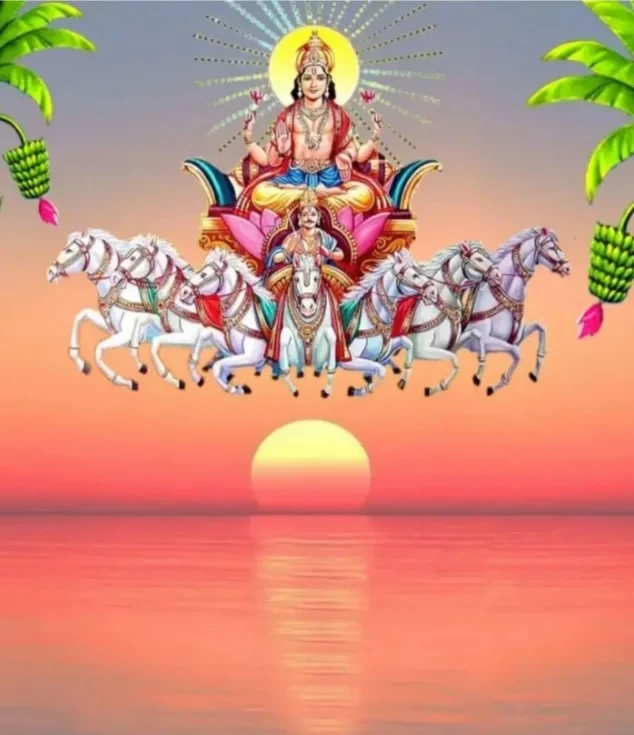
One of the most extraordinary facets of Chhath is its worship of the setting sun. The world universally celebrates the dawn, associating the rising sun with dreams of success, potential, and prosperity. Yet, Chhath expresses an equal measure of gratitude toward the sun as it completes its daylong journey and dissolves behind the horizon. This is not merely a ritualistic practice; it is an extraordinary perspective on life itself. Whatever rises must eventually set. Whatever is at its peak today must descend one day. Youth gives way to old age, achievements are followed by rest, and every beginning moves inexorably toward its completion. Yet, setting does not mean erasure. The sun sinks below the horizon, but its significance does not end.
Chhath seems to whisper to humanity: Learn to respect what was honorable in your life at its dawn just as deeply at its dusk.
Modern society perhaps needs this philosophy more than ever. We chase rising figures and forget those whose influence is waning. We celebrate individuals seated in positions of power, but lose our regard for them the moment they step down. The setting sun of Chhath poses a silent question to this societal tendency. It reminds us that respect should be anchored in contribution, not merely in raw power or capacity. A person who has served society does not lose their inherent value simply because their utilitarian role has diminished.
The tradition of sun worship in Indian civilization is exceptionally ancient. Hymns dedicated to Savita, Surya, and other solar deities fill the Rigveda, while the Gayatri Mantra invokes the divine brilliance of Savita to guide human intellect. To the Vedic mind, the sun was not merely a glowing celestial sphere in the sky, but the very momentum of life, the discipline of time, and the primeval energy of nature. For them, sunrise was not just an astronomical occurrence, but a reassuring guarantee of the continuity of life in the universe.
Although viewing contemporary Chhath practices as an entirely unchanged relic of the Vedic era would be historically inaccurate, the festival beautifully harmonizes ancient solar worship, the veneration of Goddess Shashti, agrarian culture, and regional folk customs. Its uniqueness lies in how classical memories and the spontaneous experiences of folk life converse with one another.
In folk tradition, Chhathi Maiya is the maternal deity governing child protection, family well-being, and the uninterrupted continuity of life. While some traditions worship her as Goddess Shashti, others revere her as the sister of the Sun God. The festival is also linked to the solar energies of Usha (dawn) and Pratyusha (dusk), where the offerings made at both thresholds of time express profound gratitude to life itself.
Folk memory weaves legendary associations with Chhath, recalling Karna’s legendary devotion to the sun, the Pandavas’ solar worship, and Draupadi’s prayers. Another popular tale recounts Lord Rama and Sita performing solar worship upon their return to Ayodhya. While these narratives may not serve as definitive historical proof of Chhath’s exact chronological origin, they deeply enrich its mythological and cultural heritage. Folk traditions possess their own distinct history—one preserved not merely in formal inscriptions, but in the living faith of the populace and stories passed down through generations.
Why has this festival penetrated the folk consciousness so deeply? Perhaps because its roots are firmly anchored in the earth. Chhath belongs to the agrarian society that looked upon solar warmth, riverwaters, and fertile soil as the absolute bedrock of survival. The farmer knows that despite his arduous labor, crops do not sprout through human effort alone; nature’s active cooperation is indispensable. Consequently, the fruits arranged in the Chhath soop (bamboo basket) are not mere offerings; they are tokens of human gratitude toward the earth.
Bananas, coconuts, sugarcane, radishes, ginger, turmeric, lemons, and seasonal fruits all declare through their quiet presence that humans do not live in isolation. Our existence is inextricably bound to trees, rivers, changing seasons, soil, and the sun. Nature is not merely an object for human consumption; it is our fellow traveler in existence.
Even the traditional offering of thekua is deeply symbolic. Crafted from wheat flour, jaggery or sugar, and ghee or oil, this humble preparation rivals any expensive confection. It carries the touch of personal labor and profound reverence rather than mere taste. When women of the household prepare thekua, they are not simply cooking; they are breathing life back into cultural memories inherited from their mothers and grandmothers. The aroma rising from the kitchen is not just the scent of food, but the invisible fragrance of intimacy linking generations.
The four-day discipline of the festival is astonishing. Beginning with Nahay-Khay—marked by ritual cleansing, personal hygiene, and pure vegetarian meals—the observance transitions into Kharna, where jaggery kheer and roti are prepared as offerings. Following this, many practitioners observe a rigorous fast of approximately thirty-six hours without water. The third evening features offerings to the setting sun, while the fourth morning concludes with prayers to the rising sun and the breaking of the fast (paran).
This spiritual discipline is arduous, rooted entirely in devotion, self-restraint, and inner resolve rather than physical claims. Because long, dry fasts carry inherent physical challenges, understanding its spiritual core without viewing it as a mandatory physical strain is essential.
A unique feature of Chhath is the absence of any mandatory priestly intermediary. The fasting devotee (vrati) stands directly at the center of worship. Women are not mere participants in a ritual; they are its primary conductors. Although men also observe the Chhath fast, mothers, grandmothers, daughters-in-law, and daughters have historically played the central role in preserving and passing down this tradition.
The bahanga moving toward the riverbank represents another picturesque image of the festival. Bamboo-crafted dauras, soops, and baskets honor the traditional artisans whose skilled hands shape the festival. The potters who bake earthen lamps, the weavers who craft bamboo baskets, the farmers who grow sugarcane, and the families who prepare the offerings all participate in this grand celebration in their own ways.
Chhath is not just a relationship between deity and devotee; it is a celebration of the invisible, harmonious cooperation among the hardworking hands of society.
The folk songs of Chhath imbue the atmosphere with an intimacy that formal prayers struggle to capture.
Kelava jare farela ghawad se…
This folk melody evokes the heavy bunch of bananas, the parrot hovering near it, and the folk mind's deep anxiety regarding the purity of the offering. Birds, trees, and humans become characters in a shared cultural universe.
Uga ho suruj dev…
This call echoes not just an anticipation of sunrise, but the eager impatience of hopes kept awake through the night. And melodies like Runki-jhunki beti mangila… express ardent prayers for the birth of a daughter and familial prosperity. It is particularly noteworthy that Chhath folk songs do not merely pray for sons; they actively invoke blessings and auspicious futures for daughters as well.
The greatest quality of these songs is their effortless simplicity. They utilize the vocabulary of everyday life, call out familial relationships, shift between gentle complaints and heartfelt pleas, and foster such deep familiarity that even the divine feels like a member of the household. This emotional closeness transforms folk songs from mere music into the emotional history of the folk consciousness.
Following the evening of Chhath, many families observe the ritual of Kosi bharna. A canopy-like structure is woven from fresh sugarcane stalks, beneath which earthen lamps are lit and offerings are arranged. This custom is closely tied to prayers for fulfillment, progeny, and familial well-being, though its exact execution varies across regions and family traditions. The small, flickering lights glowing amidst the sugarcane stalks resemble the living canvas of a rural folk painter—the dark night of Kartik outside and the steady glow of hope preserved by the family amidst life’s countless trials.
The night of Chhath is not merely a night of rest; it is a night of vigilant anticipation. Families moving toward riverbanks before dawn, men balancing baskets on their heads, women carrying offerings, and children blinking sleepily against the dark have become the permanent cultural signature of rural life in Bihar and eastern Uttar Pradesh.
The gradual shift of the morning sky from gray to pink and then gold, the trembling reflection of the first sunray on the river’s surface, and the moment devotees offer arghya to the rising sun capture an extraordinary dialogue between nature and humanity.
The evening arghya symbolizes gratitude, while the morning arghya represents hope. One acknowledges the completion of life, while the other greets its fresh beginning.
This encapsulates the profound philosophy of Chhath: Honor what is setting; welcome what is rising.
Another profound dimension of Chhath lies within the hearts of migrant workers who live far from their native villages due to employment and life's demands. When a person residing in Delhi, Mumbai, Kolkata, Dubai, London, or any distant city hears a Chhath song, the experience transcends a mere visual spectacle. Their ancestral home flashes before their eyes—the earthen courtyard, the mother’s face, the village pond, the father’s shoulder carrying the basket, and the familiar footpath leading to the riverbank.
Though humans may travel thousands of miles away from their birthplace, a single folk melody transports them back in an instant. For the diaspora, Chhath is far more than a religious marker; it is an umbilical cord connecting them to their roots. The makeshift riverbanks in bustling metropolises, collective community preparations, and sun-worship rituals organized in distant foreign lands stand as powerful testimonies to this cultural continuity. Geographical distances may stretch, but the roots of folk memory do not dry up so easily.
With the Usha-arghya and paran, the four-day ritual of Chhath concludes. Offerings are distributed, families return to their homes, and the bustling riverbanks gradually dissolve back into routine daily life. Yet, the emotional resonance of this grand festival does not fade with the rituals.
It remains alive in the memories of children who grow up watching their mothers offer arghya to the sun. It lingers in the heart of a daughter learning an ancient Chhath melody from her grandmother. It dwells in the moist eyes of a migrant suddenly overcome by longing for his village. And it breathes within the consciousness of every individual who bows before nature, realizing that humility is not a sign of weakness, but the ultimate proof of human maturity.
Chhath teaches us that life is not merely about acquiring; it is about being grateful. Taking from nature requires an equal sense of responsibility toward it. Welcoming success is graceful, but honoring declining phases of life is no less beautiful.
Perhaps the greatest miracle of Chhath is this: seeking light from the sun, the human being slowly begins to understand the true meaning of light itself.
The ultimate prayer of this festival transcends worldly wishes for prosperity and progeny. Its deeper aspiration is that we awaken within ourselves the wisdom to embrace every sunrise and every sunset with equal dignity.
For the sun rises and sets every single day, but the sunrise of true gratitude within the human soul happens all too rarely.
The very day that inner sun rises within us, our celebration of Chhath will truly be fulfilled—not just on the riverbank, but in the deepest chambers of our lives.
What's Your Reaction?
 Like
0
 Dislike
0
 Love
0
 Funny
0
 Wow
0
 Sad
0
 Angry
0












Comments (0)