
DHRAMAVATI RIVER IS NOW GASPING FOR SURVIVAL
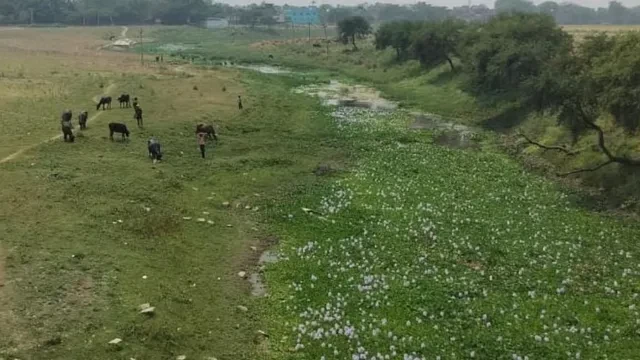
-The Dharmavati River, often called the lifeline of the Diyara region in Bhojpur, is currently struggling for its very existence. Once a perennial stream that flowed uninterrupted throughout the year, it now begins to dry up in various stretches as soon as the summer heat sets in.

DHRAMAVATI RIVER IS NOW GASPING FOR SURVIVAL
23-NOV-ENG 16


RAJIV NAYAN AGRAWAL
ARA-------------------------The Dharmavati River, often called the lifeline of the Diyara region in Bhojpur, is currently struggling for its very existence. Once a perennial stream that flowed uninterrupted throughout the year, it now begins to dry up in various stretches as soon as the summer heat sets in.
The river, which once provided water to quench the thirst of villagers, irrigate fields, and sustain livestock, is now burdened by an ever-increasing accumulation of silt, sediment, water hyacinth, and untreated wastewater discharged from nearby villages.
This transformation of the river raises serious concerns regarding the environment and agriculture of the Diyara region, as well as the potential for a severe water crisis in the future.
The Dharmavati River was once akin to the main stream of the Ganges.
The history of the Dharmavati River is both ancient and illustrious. Elders from the villages along its banks recall that, as recently as 50–60 years ago, the river resembled the main course of the Ganges.
It is said that the river is even mentioned in the 'Harshacharita', a work by the great poet Banabhatta. Originating from the Kav River near Old Bhojpur in Buxar, the Dharmavati flows through the Simri and Brahmpur blocks, entering the Bhojpur district at Sarna in the Shahpur block. It eventually merges with the Ganges near Barja village in the Sadar block.
Vinod Mishra, the Sarpanch of Bharauli, notes that until about 30 years ago, the Dharmavati River flowed year-round. Even during the summer months, villagers would fetch water from the river for cooking—such as preparing lentils—and for drinking.
The water was so pristine that people consumed it without any hesitation. Herdsmen grazing their cattle would even prepare *sattu* (a traditional roasted gram flour meal) along the riverbank, quenching their thirst with the very same water. Rajendra Prasad Singh, alias Upadra Singh, from Suhiya village, recounts that clear water used to emerge from the sand along the riverbank. By removing the top layer of white sand, one could find pure, accumulated water underneath, which the villagers used for drinking.
According to Mahavir Ojha from Sahjauli, the river water was once so clean that people would mix *sattu* (roasted gram flour) in a *gamchha* (traditional cloth) and eat their meals right by the riverbank—a common part of daily rural life.
Villagers point to several reasons for the disruption of the Dharmavati River’s flow, most notably the accumulation of silt on the riverbed, the discharge of wastewater from nearby villages directly into the river, and soil erosion along the banks.
Soil washed down from fields and surrounding land has accumulated in the river, gradually forming a thick layer of silt. This has steadily reduced both the river's depth and its capacity to hold water.
Villagers estimate that the riverbed has risen by more than two meters over the last five decades. In several stretches—from Sarna and Bharauli to Bariswan—the riverbed has become almost entirely flat, whereas these areas were once three to four meters deep.
The impact of this transformation is most evident during the summer months. By April and May, the river becomes increasingly choked with water hyacinth and other aquatic vegetation.
In many places, the water dries up, and the river’s continuous flow is broken into isolated patches. Once a perennial river, it now struggles for water during the summer—a situation that has compounded the hardships faced by the villagers, farmers, and livestock herders who depend on it.
A collective initiative is now essential to save the Dharmavati.
The Dharmavati River is more than just a source of water; it is vital to the region’s agriculture, animal husbandry, groundwater levels, environment, and rural heritage. If timely action is not taken to save it, future generations may be deprived of this crucial water resource. To conserve the river, it is essential to survey its actual depth and water flow, identify and clear areas where silt has accumulated, treat wastewater from drains before it enters the river, and prevent soil erosion along the banks.
Revitalizing the Dharmavati River now requires public participation. Join the campaign by *Dainik Jagran* to highlight the river's dire state and share your suggestions for its conservation. Send your thoughts and photographs to us via WhatsApp at 7004632959. Your voice can strengthen the initiative to save the river.
What's Your Reaction?
 Like
0
 Dislike
0
 Love
0
 Funny
0
 Wow
0
 Sad
0
 Angry
0










Comments (0)