
DAWN OF A NEW STRATEGIC PARTNERSHIP: LALIT GARG
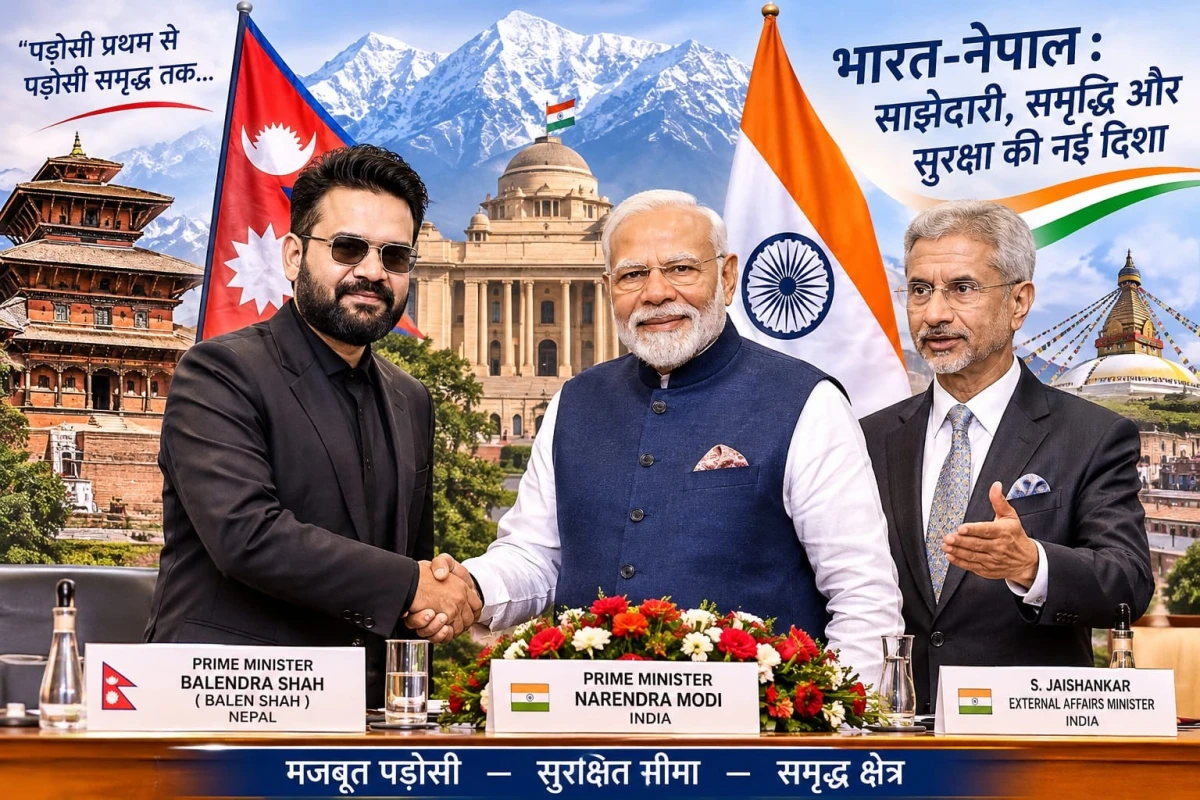
-The visit of Nepalese Prime Minister Balen Shah to India is not merely a routine foreign trip by a head of government; it signals a potential new beginning in India-Nepal relations. Since assuming office in March, this marks his first bilateral visit abroad, with India as his chosen destination. Although he traveled to the United States in September for the United Nations General Assembly, that was not a bilateral state visit. In this context, his stop in New Delhi holds particular significance. The visit is also noteworthy because, following Balen Shah’s rise to power, Nepal’s foreign policy had begun to exhibit a different tone. Some of his remarks regarding India caused unease, even as Nepal’s economic and strategic engagement with China continued to grow. Yet, in foreign policy, enduring friendship and transient disagreements often coexist. The adage "better late than never" aptly captures the spirit of Balen Shah’s arrival in New Delhi.

DAWN OF A NEW STRATEGIC PARTNERSHIP: LALIT GARG
24-NOV-ENG 10


RAJIV NAYAN AGRAWAL
ARA-----------------------The visit of Nepalese Prime Minister Balen Shah to India is not merely a routine foreign trip by a head of government; it signals a potential new beginning in India-Nepal relations. Since assuming office in March, this marks his first bilateral visit abroad, with India as his chosen destination. Although he traveled to the United States in September for the United Nations General Assembly, that was not a bilateral state visit. In this context, his stop in New Delhi holds particular significance. The visit is also noteworthy because, following Balen Shah’s rise to power, Nepal’s foreign policy had begun to exhibit a different tone. Some of his remarks regarding India caused unease, even as Nepal’s economic and strategic engagement with China continued to grow. Yet, in foreign policy, enduring friendship and transient disagreements often coexist. The adage "better late than never" aptly captures the spirit of Balen Shah’s arrival in New Delhi.
For its part, India has never closed the door on this relationship. Following the devastating floods in August, India provided Nepal with emergency aid, relief supplies, and technical support. This gesture went beyond mere humanitarian assistance; it served as a reminder that in times of crisis, it is one’s neighbor who is the first to offer help. The relationship between India and Nepal transcends standard diplomatic agreements. The two nations share an open border, deep-rooted religious and cultural affinities, marital ties, long-standing pilgrimage traditions, and extensive linguistic and social connections—all of which have endured for centuries. Places like Janakpur and Ayodhya, Pashupatinath and Kashi, Lumbini (the birthplace of the Buddha) and India’s own Buddhist heritage are not merely tourist destinations; they are milestones of a shared cultural consciousness. However, in today’s world, the traditional concept of a "bond of bread and kinship" (*roti-beti ka rishta*) is no longer sufficient on its own. While sentiments hold their own place, economic interests, technology, energy, security, and connectivity have emerged as the new language of modern bilateral relations. Therefore, it is the need of the hour to move India-Nepal relations beyond their emotional legacy and transform them into an economic and strategic partnership.
Nepal requires capital, technology, employment opportunities, an energy market, and better connectivity for its development—areas in which India possesses significant capacity. Conversely, India desires a stable, prosperous, and friendly Nepal. Thus, the interests of the two nations are characterized more by complementarity than by fundamental conflict. Balen Shah’s visit to India carries an inherent diplomatic message. His predecessor, K.P. Sharma Oli, had departed from an established, albeit informal, tradition by choosing China as the destination for his first official foreign visit. While Balen’s decision to begin his engagement with India does not necessarily imply that Nepal is distancing itself from China, it does underscore that New Delhi holds a natural and significant place in Kathmandu’s foreign policy. Today, Nepal seeks to strike a balance between India and China—a necessity dictated by its geographical and economic reality. India recognizes this; rather than pushing Nepal into any particular camp, it can foster a partnership that offers Nepal a broader range of development options while respecting its independent foreign policy. This represents a true diplomatic test for India: to demonstrate to Nepal that India does not limit its choices, but rather expands them. During Balen Shah’s visit, Nepal requested approximately two billion dollars in grants and concessional loans. India has responded positively to these economic proposals, though discussions regarding the final package and its structure are ongoing. A full consensus has yet to be reached on the issue of air routes as well. This is where India should adopt a fresh perspective.
Merely providing aid to Nepal is insufficient; it would be far more beneficial for India to partner in projects that foster self-reliance within the Nepalese economy. Hydropower serves as the prime example. Nepal possesses vast hydroelectric potential, while India has an escalating need for clean energy. Through long-term power trade, transmission infrastructure, and new hydroelectric projects, both nations can develop a model wherein Nepal generates electricity and India provides the market—a framework that would lead to prosperity for both. The target of long-term electricity trade of up to 10,000 megawatts between India and Nepal is a significant step in this direction. Projects like the Pancheshwar Multipurpose Project and the Lower Arun Hydropower Project, along with cross-border power interconnections and new energy corridors, cannot simply be left buried in files of past disagreements. It is high time—as the saying goes, "better late than never"—for both nations to translate these long-pending projects into tangible, on-the-ground results. Connectivity should be the next major chapter in India-Nepal relations. Railways, roads, pipelines, digital networks, and air links serve as the vital arteries of modern-day diplomacy. The operationalization of the Ayodhya-Janakpur rail link is significant from both cultural and tourism perspectives. Similarly, the proposed Raxaul-Kathmandu rail link could redefine the future of trade and the movement of people. The expansion of Integrated Check Posts (ICPs) at the border, energy pipelines, and trade corridors has the potential to further integrate the economies of both countries. The request for additional Indian air routes to serve airports in Nepal—such as those in Bhairahawa and Pokhara—is also a significant matter; it requires finding practical solutions that account for security, technical, and airspace-related considerations. Border disputes concerning areas like Kalapani, Lipulekh, and Limpiyadhura remain a sensitive reality in the bilateral relationship. Furthermore, issues such as the review of the 1950 India-Nepal Treaty, the recruitment of Gorkha soldiers, trade imbalances, and the Pancheshwar project have, from time to time, been sources of tension. These disputes can neither be ignored, nor would it be appropriate to make them the sole focus of every meeting. The way forward lies in dialogue, a commitment to facts, mutual sensitivity, and political maturity.
Any discussion on India-Nepal relations remains incomplete without considering the role of China. Nepal is also collaborating with China on projects related to roads, energy, connectivity, and the ‘Belt and Road’ initiative. Rather than viewing this solely through the lens of geopolitical rivalry, India should seek to understand Nepal’s own developmental aspirations. The best strategy for India would be to convey to Nepal: “The path to your development is yours to choose, but on that journey, India remains your trusted neighbor and partner.” Through its own capabilities, India must demonstrate to Nepal that its partnership—spanning democracy, development, employment, education, healthcare, the digital economy, and energy—is a long-term commitment. Trust is built not through coercion, but through conduct. India’s ‘Neighborhood First’ policy now requires a more comprehensive approach; relations with neighboring nations should extend beyond mere aid or political engagement, and instead be anchored in a platform for shared economic growth. One possibility is for India to develop a new multilateral framework for cooperation with neighbors like Nepal, Bhutan, Bangladesh, Sri Lanka, and the Maldives—covering areas such as joint development, disaster management, energy, digital connectivity, and trade. For those neighboring countries willing to participate (excluding Pakistan), such a collaborative structure could bolster India’s positive influence in South Asia. This would not be a military alliance, but rather a partnership centered on development and human security—where electricity, water, roads, railways, digital payments, disaster relief, healthcare, education, and tourism serve as catalysts for shared prosperity.
Nepal is the most natural starting point for such a model. An economic corridor could be forged, stretching from the Himalayas to the Bay of Bengal, linking Nepal’s hydropower potential with India’s market and Bangladesh’s energy requirements. This could provide fresh momentum to the regional economy. Balen Shah’s visit to Delhi should not merely be an opportunity to ‘reset’ relations; it should be an occasion to ‘re-imagine’ them. Today, a new voice is emerging from the Himalayan heights—a call for partnership, prosperity, and collective security. If the aspirations of the new generation—represented by figures like Balen Shah—align with Prime Minister Narendra Modi’s ‘Neighbourhood First’ policy, India-Nepal relations could emerge as a new model for cooperation in South Asia. As the saying goes, “one plus one makes eleven” (implying that the whole is greater than the sum of its parts). By combining their strengths, India and Nepal could achieve far more together than either could on its own. From Delhi to Kathmandu, it is possible to foster not just a spirit of friendship, but a fresh wave of development. This should be the new strategic vision for India-Nepal relations.
What's Your Reaction?
 Like
0
 Dislike
0
 Love
0
 Funny
0
 Wow
0
 Sad
0
 Angry
0









Comments (0)