
CM INAUGURATED SONEPUR FAIR
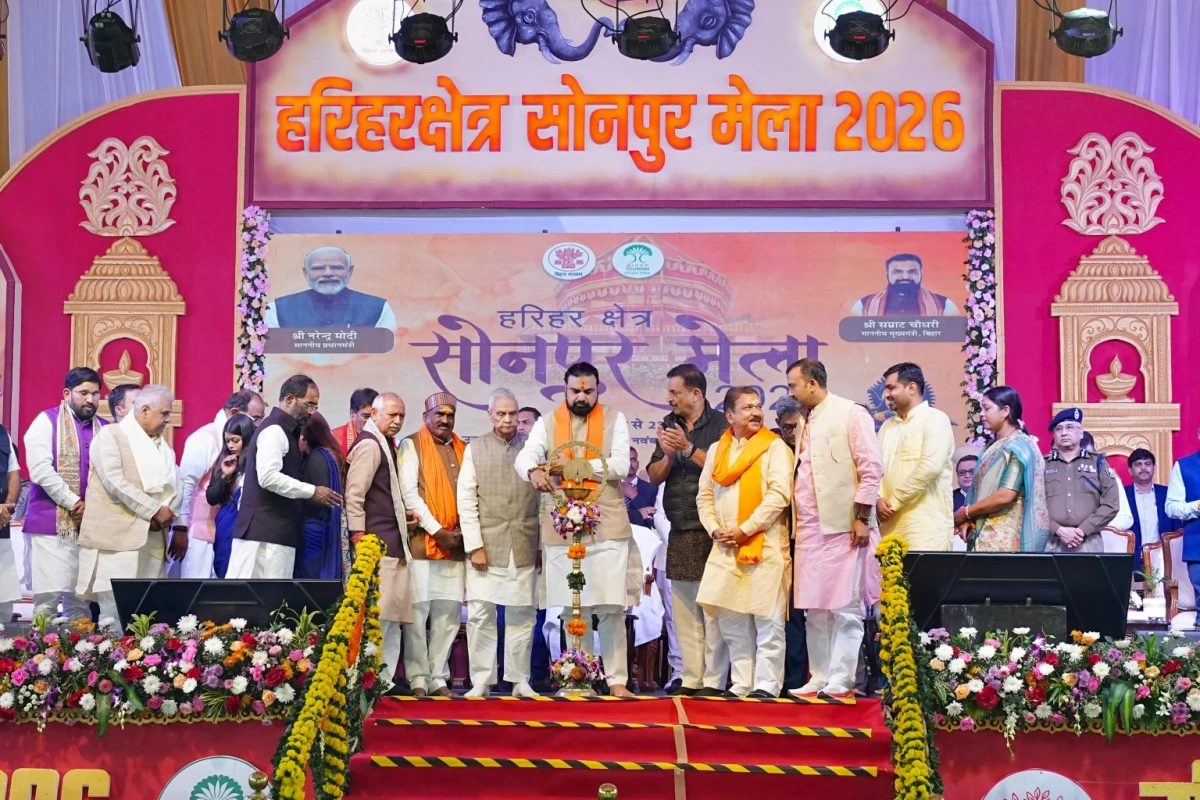
Bihar Chief Minister Samrat Chaudhary visited the historic Baba Hariharnath Temple in Sonepur, Saran district, offering prayers for the well-being, peace, and prosperity of the state. The visit marked the formal beginning of the world-renowned Harihar Kshetra Sonepur Mela-2026, a month-long event that the state government is positioning as a global-scale celebration of Bihar’s cultural heritage, religious traditions, and economic potential.

CM INAUGURATED SONEPUR FAIR
23-NOV-ENG 2
RAJIV NAYAN AGRAWAL
PATNA------------------------Bihar Chief Minister Samrat Chaudhary visited the historic Baba Hariharnath Temple in Sonepur, Saran district, offering prayers for the well-being, peace, and prosperity of the state. The visit marked the formal beginning of the world-renowned Harihar Kshetra Sonepur Mela-2026, a month-long event that the state government is positioning as a global-scale celebration of Bihar’s cultural heritage, religious traditions, and economic potential.
Following the prayers, the Chief Minister inaugurated the fair by lighting a ceremonial lamp. On the same occasion, he launched the official website, mobile application, and an AI-driven chatbot dedicated to the Sonepur Mela-2026 through a remote-controlled interface. A short film titled “Gajendra Moksha: An Immortal Saga of Devotion, Faith, and Divine Grace” was also screened, underscoring the spiritual narrative associated with the region. Organised by the Tourism Department of the Government of Bihar, the fair is scheduled to run from 22 November to 23 December 2026.
In his address, Chaudhary paid obeisance at the feet of Lord Hariharnath and set out an ambitious vision that goes far beyond the traditional cultural and religious dimensions of the mela. He stressed that the Sonepur Mela must not remain limited to a seasonal cultural or religious gathering. Instead, he said, it should be deliberately integrated into Bihar’s economy so that it becomes a major catalyst for development and employment generation. The Chief Minister called for collective efforts to transform the fair into a premier global hub encompassing tourism, trade, employment, and broader economic activity that meets international standards while retaining its historical and spiritual identity.
Several concrete infrastructure and economic announcements accompanied the vision. Chaudhary declared that the world’s largest airport would be constructed in Sonepur, accompanied by the development of a modern township. He announced that desilting operations would be undertaken in the Ganga and Gandak rivers to improve navigability and environmental conditions. Two major road projects—the ‘Ganga Ambika Path’ and the ‘Narayani Path’ connecting Sonepur to Gopalganj—were flagged to enhance regional connectivity and stimulate economic activity. The Chief Minister further stated that products manufactured through food-processing units in Sonepur and surrounding areas would be introduced to international markets, creating new opportunities for local farmers, entrepreneurs, and the youth.
On the connectivity front, he announced that the Sonpur-Hajipur bridge would be expanded from two lanes to four lanes, with the upgraded facility expected to become operational before June of the following year. Perhaps the most significant religious-tourism commitment was the announcement that the Baba Hariharnath Temple would be redeveloped at a cost of ₹1,000 crore. Chaudhary said the project would strengthen religious tourism and help establish Sonepur as a significant destination at both the national and international levels. He described the Sonepur Mela as a living symbol of Bihar’s cultural heritage, religious faith, and social harmony, and affirmed the government’s commitment to developing it into a world-class event equipped with modern amenities while carefully preserving its historical character. The fair, he reiterated, would be systematically linked with economic activities, tourism, trade, and employment generation.
The Chief Minister emphasised that the transformation of Bihar into a developed state required the collective participation of all sections of society. He expressed the government’s resolute commitment to the holistic development of the state and to elevating it to new heights. Members of Parliament Rajiv Pratap Rudy and Janardan Singh Sigriwal also addressed the gathering, reinforcing the developmental message.
In a related and significant policy announcement made during his Sonepur visit, Chief Minister Samrat Chaudhary unveiled a consensus-driven land acquisition framework designed to accelerate infrastructure and urban development projects without resorting to coercive measures. Addressing a public gathering, he outlined a set of assurances aimed at securing the voluntary participation of farmers and landowners.
Under the new approach, landowners who voluntarily offer their land will receive an additional 10 per cent over the applicable compensation rate. The Chief Minister noted that standard rural land acquisition already provides compensation at four times the base rate; the extra 10 per cent is intended as an incentive for those who come forward willingly. He also detailed a land-return model: if a landowner contributes 100 kattha of land, the government will return 55 per cent (55 kattha) after developing the area with modern civic amenities, including paved roads, a sewage treatment plant, piped water supply, and public parks. Emphasising democratic accountability, Chaudhary stated that the administration would not force any landowner to part with their property, describing elected representatives as public servants and citizens as the true stakeholders.
Linking the land policy to the broader infrastructure roadmap, the Chief Minister said the state government is working to build modern expressways and elevate regional facilities to international standards. He highlighted the unique geographical characteristics of the region, observing that the Ganga expands from a width of roughly 5–6 kilometres when entering Bihar to nearly 9–10 kilometres near the Sonepur stretch. He reassured residents that their concerns continue to be heard at the highest levels, noting that local public representatives regularly visit Patna to raise regional issues whenever problems arise on the ground.
Taken together, the day’s events and announcements present a comprehensive package for Sonepur and the surrounding region. The combination of temple redevelopment on a massive scale, the push to globalise the Sonepur Mela, major transport and connectivity projects, river management works, and a land-acquisition model designed to secure voluntary participation signals an attempt to position the area as both a spiritual destination and an economic growth node. The ₹1,000-crore temple project, the proposed airport and township, the four-laning of the Sonpur-Hajipur bridge, and the new road corridors are intended to create the physical infrastructure necessary for larger tourist inflows and commercial activity. Parallel efforts to market local food-processing products internationally and to expand employment opportunities are meant to ensure that the benefits reach farmers, entrepreneurs, and young people.
The land policy, if implemented as announced, seeks to reduce friction in project execution by offering financial incentives and a partial return of developed land rather than relying solely on compulsory acquisition. By publicly committing to a no-coercion approach and framing elected representatives as accountable to citizens, the Chief Minister has sought to build political and social legitimacy for the development agenda in a region where land remains a sensitive issue.
Whether these ambitious plans translate into tangible outcomes will depend on execution, funding, coordination among departments, and sustained political will. For the present, the inauguration of the Sonepur Mela-2026 and the accompanying announcements have placed Sonepur firmly on the state’s developmental map. The fair itself, running for a full month, will serve as an immediate platform to showcase Bihar’s cultural and religious traditions while the longer-term infrastructure and economic initiatives take shape. Chief Minister Samrat Chaudhary’s message was clear: the historic Harihar Kshetra must evolve from a seasonal gathering into a year-round engine of tourism, trade, employment, and regional prosperity, supported by modern infrastructure and a land policy that prioritises consensus over compulsion.
What's Your Reaction?
 Like
0
 Dislike
0
 Love
0
 Funny
0
 Wow
0
 Sad
0
 Angry
0






Comments (0)