
THEFT AT BHALUNI DHAM TEMPLE, FOUR POLICE PERSONNEL SUSPENDED
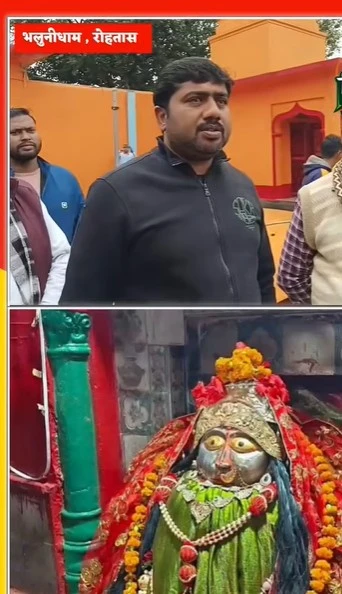
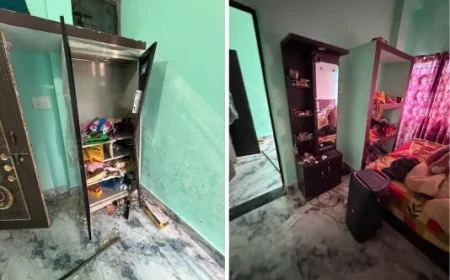
-In the early hours of a Saturday night in mid-November 2026, an audacious theft struck one of the most revered spiritual sites in Bihar’s Rohtas district. Unknown thieves broke into the sanctum of Maa Bhaluni Bhawani Temple, popularly known as Bhaluni Dham or the sacred abode of Mai Yakshini, located in the Dinara area. Under the cover of darkness, they forced open the lock of the garbhagriha, removed the deity’s crown and a large collection of gold and silver ornaments, and vanished without a trace. The crime, discovered only the following morning, has triggered widespread anger among devotees, sharp criticism of security arrangements, administrative action against local police personnel, and demands for stronger permanent protection of the ancient shrine.

THEFT AT BHALUNI DHAM TEMPLE, FOUR POLICE PERSONNEL SUSPENDED
23-NOV-ENG 1
RAJIV NAYAN AGRAWAL
SASARAM------------------------In the early hours of a Saturday night in mid-November 2026, an audacious theft struck one of the most revered spiritual sites in Bihar’s Rohtas district. Unknown thieves broke into the sanctum of Maa Bhaluni Bhawani Temple, popularly known as Bhaluni Dham or the sacred abode of Mai Yakshini, located in the Dinara area. Under the cover of darkness, they forced open the lock of the garbhagriha, removed the deity’s crown and a large collection of gold and silver ornaments, and vanished without a trace. The crime, discovered only the following morning, has triggered widespread anger among devotees, sharp criticism of security arrangements, administrative action against local police personnel, and demands for stronger permanent protection of the ancient shrine.
Bhaluni Dham holds deep religious and cultural significance in the region. Devotees regard it as a powerful Shakti Peeth dedicated to Maa Yakshini Bhawani, an embodiment of Adishakti. The temple complex and surrounding eco-park attract hundreds and sometimes thousands of pilgrims daily, especially during festivals. Its spiritual heritage is closely linked with local traditions, the panda families who have maintained worship practices for generations, and the long-standing efforts of community organisations such as the Sri Yakshini Bhojpuri Sahitya Samiti, founded in 1981. The Samiti has worked for decades on literature, culture, education, environmental protection, and the preservation of the dham’s natural and cultural legacy, including its forests, water bodies, and public facilities.
The theft itself appears to have been carefully timed. According to accounts from temple staff and local reports, the intruders entered the temple premises during the night, taking advantage of the darkness and the apparent absence of effective night-time security. They targeted the main shrine, breaking the lock and systematically removing valuable items of shringar that adorn the deity. Among the stolen articles were the mukut (crown) of Maa Rani, described in some reports as a silver crown offered by the local MLA, along with gold and silver ornaments, a canopy or chhatri, a nose ring (nathiya), tika, garland, silver footwear (charan paduka), and silver eyes from the lion figures at the temple entrance. Additional items mentioned include the gold eye of Hanuman, the eye of the tiger (bagh), and six charan paduka belonging to Mata Rani. The thieves left the premises in disarray, with articles scattered around the complex.
When the temple priest arrived early on Sunday morning to perform the daily puja and archan, the sight that greeted him caused immediate alarm. Valuable items were missing and the sanctum showed clear signs of forced entry and ransacking. The priest promptly informed the local police. Word of the incident spread rapidly through the surrounding villages and among the devotee community. What began as a local shock quickly grew into a wave of public indignation. For many, the theft was not merely a property crime but an assault on collective faith. The crown and ornaments that devotees had offered with reverence, and that symbolised the presence and splendour of the goddess, had been stolen from the very place where people came to seek blessings and solace.
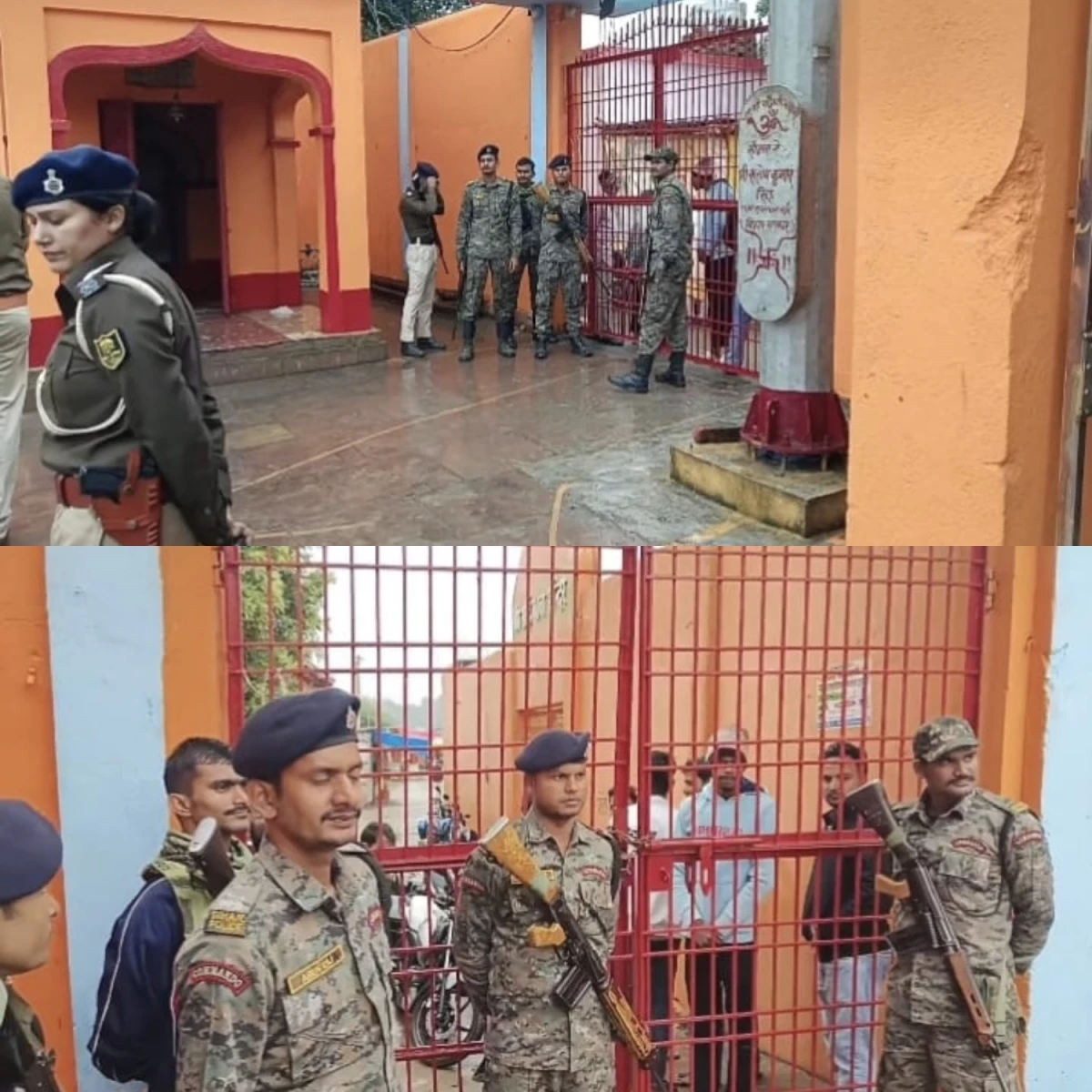
Police from Dinara thana reached the scene soon after receiving the information. Officers inspected the site, began assessing the list of missing items, and started questioning people in the vicinity. CCTV cameras installed in and around the temple complex became a key focus of the investigation. Footage was reviewed in an attempt to identify the culprits. Later reports indicated that the footage captured a young man in the act of removing the gold and silver crown, and police released a photograph of the suspect to aid public identification. The seriousness of the case prompted higher-level intervention. The Superintendent of Police of Rohtas visited the temple, examined the premises, reviewed the available CCTV material, and issued necessary directions. Under the SP’s instructions, a Special Investigation Team was constituted under the leadership of the Sub-Divisional Police Officer of Bikramganj. The SIT has been tasked with tracing the thieves, recovering the stolen ornaments, and examining the broader security lapses that allowed the crime to occur. Raids on suspected locations have also been reported as part of the ongoing probe.
Administrative accountability followed swiftly. The SP placed four police personnel under suspension with immediate effect on charges of negligence of duty. The suspended officers included two Sub-Inspectors, Shambhu Sharan Paswan and Chauhan, along with two other police personnel (reports refer to a total of four, including three constables in some accounts). The SP made it clear that carelessness in security matters would not be tolerated. The suspensions came against the backdrop of earlier announcements, made during a recent festival, about establishing a police outpost at the dham—announcements that, in the eyes of many locals, had not been followed through with lasting arrangements.
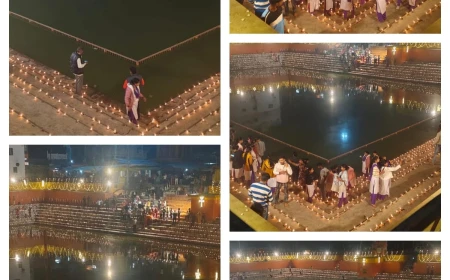
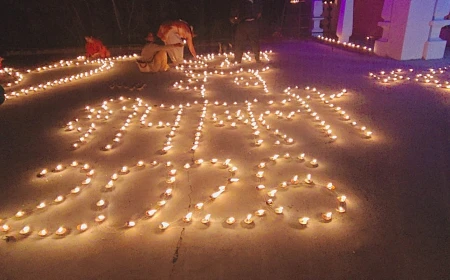
The timing of the theft has intensified public anger. Only days earlier, on 14 November, the district administration had organised a grand Maa Bhaluni Bhawani Mahotsav at the temple. The event was marked by elaborate arrangements, lighting, stage decorations, and the presence of Bhojpuri film star Pawan Singh, NDA workers, public representatives, and senior officials. Significant public funds were spent on the celebrations. Photographs were taken, speeches delivered, and the occasion projected as a moment of devotion and administrative attention. Yet once the festival ended, critics argue, the temple was left without adequate night security, continuous CCTV monitoring, or a permanent guard presence. Devotees and local commentators have asked pointed questions: if large sums could be spent on a one-day festival, why could basic measures—a sturdy lock, functional night-time CCTV coverage, or a dedicated night watchman—not be ensured on ordinary days? The contrast between the festive spectacle and the subsequent vulnerability of the shrine has fuelled accusations of prioritising optics over genuine protection of the site.
Local voices have been vocal and consistent in their demands. Representatives of the panda community, villagers, and social workers have called for the swift arrest of the thieves, recovery of the stolen crown and ornaments, and the imposition of strict punishment. Amit Rai, a local mukhiya representative and social worker associated with neighbouring panchayats, described the incident as deeply unfortunate and condemnable. He noted that the local MLA, upon learning of the theft, left Patna and was expected to reach the site. Devotees have insisted that the crime represents a betrayal of faith and that the administration must treat it with corresponding seriousness.
The Sri Yakshini Bhojpuri Sahitya Samiti has issued a detailed statement articulating both immediate and long-term concerns. The committee’s secretary, Advocate Harshnath Pandey, along with other members, described the theft of the goddess’s ornaments as highly condemnable and deeply wounding to public faith. They have demanded an impartial, prompt, and transparent investigation, the earliest possible recovery of the stolen jewellery, and stringent legal action against those responsible. Beyond the immediate case, the Samiti has urged the state government, and specifically Bihar Chief Minister Samrat Chaudhary, to take cognisance of the incident and to ensure lasting measures for the security and overall development of the Bhaluni Dham area. Their demands include the establishment of a full-time police outpost or thana, a primary health centre to serve the large number of daily visitors (including women, children, and elderly pilgrims), stronger protection and development of the jungle and eco-park, conservation of the four ancient ponds (talaabs), and continued support for the public library built with community cooperation.
The Samiti has recalled the lifelong work of its founder, the late Kanhaiyalal Pandit, often referred to locally as the “Mahamana Malaviya” of the Bhaluni region. Pandit had devoted himself to protecting the religious, spiritual, and cultural heritage of the dham, along with its water, forests, land, environment, and public amenities. The committee has framed the current crisis as a test of collective responsibility to preserve that legacy. It has appealed to the administration, the devotee community, and local residents to uphold the spiritual dignity, traditional worship practices, and natural-cultural heritage of the ancient site. The message is clear: crime must be met with firm action, security arrangements must be strengthened, and the dignity of faith and tradition must remain intact.
Senior officers including the DSP and the SDM of Bikramganj have also visited the temple and initiated further inquiries. Despite these steps, many devotees remain unconvinced that temporary measures will suffice. Questions continue to be raised about the overall state of security at religious places across the region. Repeated incidents of theft at temples have, in the view of local people, exposed gaps in policing and administrative priority. The Bhaluni Dham case has become a focal point for these larger concerns. Residents and pilgrims are asking when permanent CCTV coverage, night patrols, and a dedicated police presence will be put in place, and when the stolen mukut and ornaments will be returned to the goddess.
The investigation is still underway. Police continue to examine CCTV footage, question potential witnesses, and pursue leads generated by the released photograph of the suspect. The SIT is expected to submit its findings in due course. Meanwhile, the suspensions of the four police personnel signal that the district leadership is prepared to act against internal negligence. Whether these actions will translate into lasting improvements in temple security remains to be seen.
For the thousands of devotees who visit Bhaluni Dham, the loss of the crown and shringar is more than a material setback. It is experienced as a violation of the sacred space itself. The scattered articles found on Sunday morning, the broken lock, and the empty place where the mukut once rested have left a collective wound. The community’s response—ranging from quiet grief to public demands for accountability—reflects the depth of attachment to the shrine and the expectation that those charged with its protection will treat that responsibility with the seriousness it deserves.
As the probe continues, the people of Rohtas and the wider devotee community wait for two outcomes above all: the recovery of the stolen ornaments and the establishment of security arrangements that will prevent any repetition of such a crime. The ancient dham of Mai Yakshini has long been a centre of faith, tradition, and cultural continuity. Its safeguarding is now a test of administrative resolve and collective will. Only when the crown is restored and the temple is secured day and night will the sense of violation begin to heal and the confidence of the faithful be fully rebuilt.
High-Speed Motorcycle Collides with Truck; Two Youths from Chandauli Returning from a Wedding Procession Die on the Spot
Ramgarh (Kaimur) — A tragic road accident occurred last night near Karmanasa—located on the Bihar-UP border along National Highway 19, within the jurisdiction of the Durgawati police station. Two youths, who were returning after attending a wedding procession near Mohania, lost control of their new motorcycle and collided with a truck. Both youths died on the spot in the horrific accident, which took place at approximately 10:35 PM.
The deceased have been identified as Abhimanyu Singh (son of Vijay Bahadur Singh) and his companion, Prince Singh—both residents of the Chandauli district in Uttar Pradesh. According to reports, the two had gone to the Mohania area in Bihar to attend a wedding. They were returning home to Chandauli on their new motorcycle late at night when the accident occurred near Karmanasa.
Eyewitnesses at the scene stated that the motorcycle was traveling at a very high speed—estimated to be between 80 and 100 km/h at the time of the crash. Due to the excessive speed, the rider lost control and slammed directly into the truck.
The impact was so severe that the new motorcycle was completely mangled, and both youths succumbed to their injuries instantly. A large crowd of local residents gathered at the scene upon learning of the incident.
What's Your Reaction?
 Like
0
 Dislike
0
 Love
0
 Funny
0
 Wow
0
 Sad
0
 Angry
0






Comments (0)