
PARLIAMENT EYES NUMBERS GAME
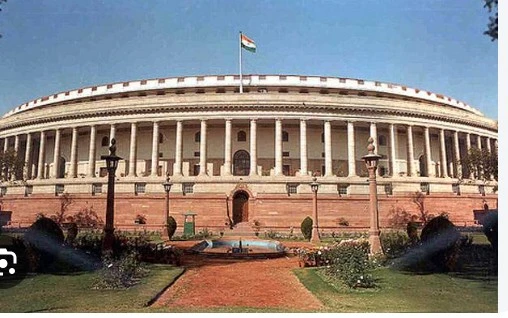
-As Parliament prepares for upcoming sittings—with the Lok Sabha scheduled to convene on November 30 and the Rajya Sabha on December 2—political attention in the national capital has sharply converged on the central government’s potential legislative push regarding delimitation and women’s reservation. While Parliamentary Affairs Minister Kiren Rijiju has indicated that essential legislative business will be taken up during these sessions, intense speculation surrounds the proposed delimitation bill and the parliamentary floor arithmetic required to see it through.

PARLIAMENT EYES NUMBERS GAME
29-NOV-ENG 1
RAJIV NAYAN AGRAWAL
DELHI-------------------------As Parliament prepares for upcoming sittings—with the Lok Sabha scheduled to convene on November 30 and the Rajya Sabha on December 2—political attention in the national capital has sharply converged on the central government’s potential legislative push regarding delimitation and women’s reservation. While Parliamentary Affairs Minister Kiren Rijiju has indicated that essential legislative business will be taken up during these sessions, intense speculation surrounds the proposed delimitation bill and the parliamentary floor arithmetic required to see it through.
At the core of the current debate is the prospect of restructuring parliamentary representation ahead of the 2029 general elections. According to reports surrounding the legislative agenda, the proposed bill is expected to expand the strength of the Lok Sabha from its current 543 seats to 850.
Such an expansion is viewed as a pivotal step toward clearing the path for implementing 33% reservation for women in both the Lok Sabha and state legislative assemblies. By linking constituency redrawing and seat expansion with gender representation, the government aims to operationalize long-awaited reforms before voters head to the polls in 2029.
Despite the government’s strategic timeline, steering a measure of this magnitude through Parliament presents a formidable legislative test. Because altering parliamentary seat structures and implementing constitutional changes require a constitutional amendment, the bill cannot be passed by a simple majority; instead, it demands the backing of a two-thirds majority in Parliament.
In the Lower House, the numbers present a tightly calculated equation:
Out of the total 543 Lok Sabha seats, three are currently vacant, leaving an effective voting strength of 540 Members of Parliament.
If all 540 sitting MPs participate in the voting process, the government will need at least 360 votes in favor to clear the constitutional threshold.
This strict numerical requirement has placed floor management and cross-party consensus at the center of political calculations. With the threshold standing at 360 votes in a full house, the key questions dominating political circles are whether the ruling coalition can mobilize sufficient numbers on its own and its allies' strength, and what stand opposition parties will take when the legislation is brought to the floor.
As the November 30 Lok Sabha sitting approaches, lawmakers, political observers, and parties across the spectrum remain closely focused on the unfolding debate and the high-stakes voting arithmetic that will determine the fate of the proposed reform.
What's Your Reaction?
 Like
0
 Dislike
0
 Love
0
 Funny
0
 Wow
0
 Sad
0
 Angry
0









Comments (0)