
ANURAG THAKUR’S FIERCE BROADSIDE AGAINST CONGRESS AND VOTE THEFT PROPAGANDA DURING ‘LOKTANTRA BACHAO, ARAJKATA HATAO MOVEMENT
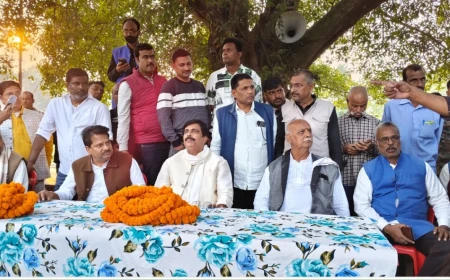
-In a powerful show of organisational strength across the historic Shahabad region, the Bharatiya Janata Party and its National Democratic Alliance partners staged a massive “Loktantra Bachao, Arajkata Hatao” (Save Democracy, Remove Anarchy) programme on Saturday that drew thousands of party workers, local residents and supporters from the four districts of Bhojpur, Buxar, Kaimur and Rohtas. The event, centred at Veer Kunwar Singh Stadium in Ara, combined a padyatra that wound through Ramna Maidan before culminating at JP Smarak with a large public meeting that transformed the area into a sea of saffron and NDA colours.

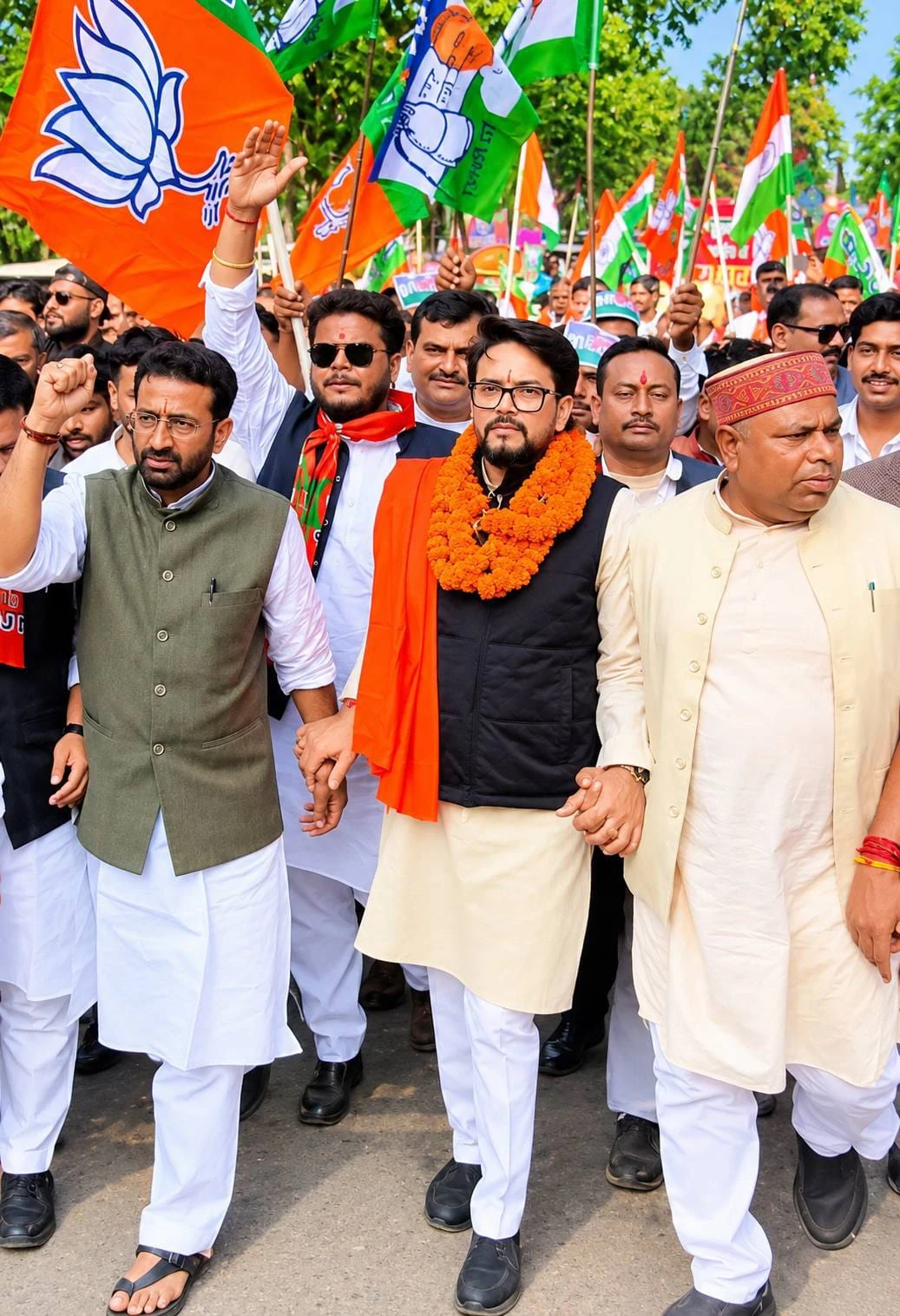
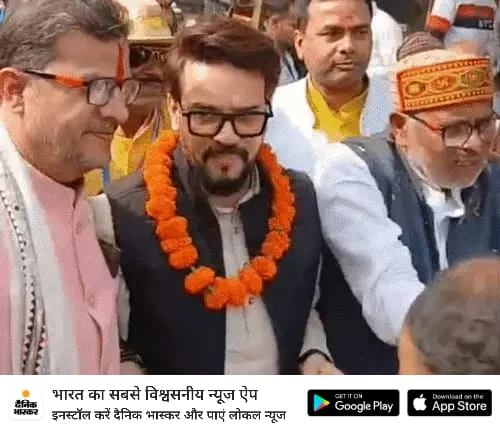
ANURAG THAKUR’S FIERCE BROADSIDE AGAINST CONGRESS AND VOTE THEFT PROPAGANDA DURING ‘LOKTANTRA BACHAO, ARAJKATA HATAO MOVEMENT
29-NOV-ENG 1
RAJIV NAYAN AGRAWAL
ARA-----------------------------In a powerful show of organisational strength across the historic Shahabad region, the Bharatiya Janata Party and its National Democratic Alliance partners staged a massive “Loktantra Bachao, Arajkata Hatao” (Save Democracy, Remove Anarchy) programme on Saturday that drew thousands of party workers, local residents and supporters from the four districts of Bhojpur, Buxar, Kaimur and Rohtas. The event, centred at Veer Kunwar Singh Stadium in Ara, combined a padyatra that wound through Ramna Maidan before culminating at JP Smarak with a large public meeting that transformed the area into a sea of saffron and NDA colours.
Former Union Minister, senior BJP leader and Member of Parliament Anurag Thakur, the chief guest, delivered a hard-hitting address that combined historical indictment of the Congress party, sharp criticism of dynastic politics represented by Rahul Gandhi and Tejashwi Yadav, defence of the Special Intensive Revision of electoral rolls, and a forward-looking pitch on women’s reservation and expansion of legislative representation. The gathering was presided over by Bhojpur BJP district president Durga Raj, while Rohtas district president Santosh Patel conducted the proceedings. Buxar district president Omprakash Bhuvan delivered the welcome address and Kaimur district president Omprakash Pandey proposed the vote of thanks.
The scale of participation was evident from the continuous stream of workers and citizens who arrived from the farthest corners of Shahabad. Organisers described the atmosphere as festive, with party flags, banners and slogans of “Loktantra Bachao, Arajkata Hatao” resonating throughout the day. Food arrangements for the large number of participants were made by several leaders. Former minister Raghvendra Pratap Singh hosted workers at his residence, MLA Vishal Prashant Singh arranged meals for people from the Tarari area and other visitors, former MP Meena Singh organised for her workers, and Asha Devi along with other leaders also contributed to the hospitality.
Among those who shared the dais with Thakur in the front row were Sanjay Tiger, Raghvendra Pratap Singh, Vishal Prashant, Radha Charan Seth, Mahesh Paswan, Rakesh Ojha, Jeevan Kumar, Bharat Bind, Meena Singh, Amrendra Pratap Singh, Asha Devi, Munni Devi and Sunil Pandey. A long list of other functionaries and workers — including Niranjan Ram, Rinki Rani Pandey, Ashok Singh, Rajeshwar Raj, Santosh Pathak, Manoj Singh, Dhanraj Sharma, Nitin Abhishek, Prabhakar Mishra, Vishal Singh (Cooperative Cell), Kanhaiya Singh (Education Cell), Rajesh Sinha, Jitendra Singh, Durga Raj, Omprakash Bhuvan, Omprakash Pandey, Santosh Patel, Bhim Singh Patel and Rohit Kushwaha of the Rashtriya Lok Morcha — were present in large numbers, underscoring the coordinated effort across the region.
Anurag Thakur opened his speech by placing the Congress party in the dock of history. “The Congress’s history has always been one of strangling democracy and pushing the country into a state of anarchy,” he declared. He reminded the audience that former Prime Minister Indira Gandhi had imposed the Emergency solely to save her own power. During those dark months, he said, the press was censored, numerous restrictions were clamped on citizens, and opposition leaders were jailed on false cases. The Emergency, in Thakur’s telling, remains the starkest illustration of how the Congress treated democratic institutions as instruments of personal and party survival rather than as pillars of constitutional governance.
He then turned to what he described as the opposition’s chronic double standards on electoral institutions. Wherever the Congress and its allies win elections, he charged, the Election Commission and Electronic Voting Machines are perfectly acceptable. The moment they lose, the same parties begin questioning the integrity of EVMs and the Commission itself. Thakur accused the opposition of even attacking the Supreme Court and attempting to bend constitutional bodies to suit their political convenience. This pattern, he argued, reveals a deeper discomfort with the people’s verdict whenever it goes against them.
A significant portion of Thakur’s address was devoted to defending the Special Intensive Revision (SIR) of electoral rolls. He explained that the process had been carried out in a transparent manner to clean the voter lists. Names of deceased persons had been deleted, duplicate entries removed, and the names of those living illegally in the country struck off. “Not a single eligible voter’s name has been removed from anywhere,” he asserted. Despite this, he said, opposition parties were spreading the false propaganda of “vote chori” (vote theft). He called upon every party worker present to go among the people and expose this narrative as a deliberate attempt to undermine public faith in the electoral process.
Thakur cited broader national figures associated with the cleaning exercise — approximately 2.80 crore deceased voters, one crore duplicate entries and 6.30 crore migrated individuals identified on the rolls — to argue that the revision was both necessary and long overdue. In a democracy as large and complex as India’s, he maintained, accurate electoral rolls are the foundation of free and fair elections. Attempts to portray legitimate purification as disenfranchisement, he warned, only served the politics of disruption.
Thakur linked the question of democratic health to the persistence of dynastic politics. He argued that genuine women’s reservation continued to face obstacles as long as leaders such as Rahul Gandhi, Sonia Gandhi and Tejashwi Yadav remained central to the opposition’s power structure. The BJP-led government, he said, was moving ahead to secure 33 per cent reservation for women in the Lok Sabha and Rajya Sabha, with the possibility of a historic decision in Parliament between 30 November and 3 December.
He placed this reform in the larger context of India’s demographic transformation. Since Independence the country’s population has nearly tripled, he noted, making an increase in the number of seats in the Lok Sabha and state assemblies both logical and necessary. He floated illustrative possibilities: Uttar Pradesh assembly seats rising from around 400 to 600, and Lok Sabha seats expanding from roughly 540 to 850. Such expansion, he argued, would create space for greater representation of women alongside general, Dalit, Scheduled Caste and Scheduled Tribe sections, thereby deepening rather than diluting democratic inclusion.
In the same breath, Thakur characterised Rahul Gandhi and Tejashwi Yadav as “failed second-generation scions of dynastic politics.” The phrase was deliberately chosen to contrast inherited political capital with the NDA’s emphasis on organisational work and delivery. By framing both leaders as products of family-run political enterprises who had failed to convert privilege into effective governance or enduring public trust, Thakur sought to strike at the heart of the opposition’s leadership narrative in Bihar and at the national level.
Thakur broadened the critique by invoking Bihar’s own political memory. Leaders and parties that had once entered public life “holding onto JP’s kurta,” he said, were today “sitting in the lap of the Congress.” The reference to Jayaprakash Narayan’s movement of the mid-1970s carried particular weight in Shahabad and across Bihar. The JP agitation had been fundamentally anti-Congress, rooted in opposition to corruption, authoritarianism and the Emergency. A generation of Bihar’s political class — including Lalu Prasad Yadav, Nitish Kumar and others — had cut their teeth in student politics and street protests under that banner.
By accusing contemporary inheritors of that tradition of aligning with the very party they once fought, Thakur attempted to strip the opposition of its anti-establishment and socialist credentials. The charge was that electoral arithmetic had overridden ideological consistency. For an audience steeped in the memory of the Emergency and the socialist struggle, the argument was designed to provoke reflection on how far present-day alliances had drifted from their founding principles.
He also recalled specific historical episodes of alleged disrespect by the Congress towards constitutional icons. Dr B.R. Ambedkar, the principal architect of the Constitution, had been insulted when he did not conform to Congress expectations. India’s first President, Dr Rajendra Prasad, had faced similar treatment for performing the inauguration of the Somnath temple. These instances, Thakur suggested, revealed a deeper pattern of treating institutions and individuals as instruments rather than as independent pillars of the Republic.
Other speakers reinforced the central themes. MLA Raghvendra Pratap Singh highlighted the massive turnout from the Barhara assembly segment as evidence of public faith in the NDA. Former MP Meena Singh stressed that public awareness remained essential to protect democracy, social justice and citizens’ rights. The presence of ministers, MLAs, MLCs and a wide range of district and organisational functionaries was presented as proof of coordinated strength across the four Shahabad districts.
At the same time, the absence of NDA MLAs from Buxar, Rohtas and Kaimur, as well as of former Legislative Council chairman Awadhesh Narayanan Singh (who later stated he was in Vindhyachal), sparked quiet political discussion about regional representation and organisational strategy. The gaps were noted but did not overshadow the overall display of numbers and energy at the Ara venue.
The NDA’s narrative did not go unanswered. RJD state general secretary Manoj Singh launched a pointed counter-offensive. Speaking in a phone interview, he questioned the very premise of a ruling coalition that has governed Bihar for two decades and the Centre for over a decade claiming to “save democracy” and “remove anarchy.” Who, he asked, is actually spreading anarchy while those in power stage marches against it?
Singh alleged that the BJP and NDA were losing ground among villagers, the poor, farmers, labourers and youth. Beyond party workers, he claimed, barely a hundred ordinary citizens had turned up at the Kunwar Singh Stadium rally. He accused the ruling side of relying on rumour and religious polarisation rather than delivering on the everyday concerns of farmers, the poor and employment. Campaigns against anarchy and in defence of democracy, he argued, traditionally belong to the opposition — a role he said Rahul Gandhi and Tejashwi Yadav continue to perform through large public gatherings, including in Delhi.
Singh also highlighted practical hardships faced by ordinary people: difficulty in securing train tickets from places such as Barhara, Chandigarh, Pune and Delhi during Chhath and Diwali, even weeks or months in advance, and shortages of hospital beds at institutions such as IGIMS and AIIMS. While the government talked of bullet trains, he charged, it ignored these daily struggles. He urged voters to remain alert and reject the ruling alliance.
The Ara programme and the accompanying rhetorical exchanges form part of a larger contest over political narrative in Bihar and beyond. For the NDA, the “Loktantra Bachao, Arajkata Hatao” campaign serves multiple purposes simultaneously. It seeks to consolidate core voters by reinforcing anti-Congress and anti-dynasty sentiments. It attempts to question the ideological coherence of the opposition by highlighting the historical tension between the JP tradition and the Congress. And it keeps public debate focused on leadership credibility, institutional integrity and electoral purity rather than allowing the opposition to dominate the conversation around local grievances, inflation or employment.
For the opposition, the counter-narrative centres on lived experience: the gap between high-flown rhetoric about democracy and the everyday difficulties of travel, healthcare and livelihood. By portraying the NDA’s democracy-saving marches as a diversion, leaders such as Manoj Singh seek to reclaim the moral high ground of popular discontent.
The debate over women’s reservation and seat expansion adds another layer. The NDA presents itself as the force capable of delivering structural reform — 33 per cent reservation and a larger House that reflects India’s demographic reality. The opposition is portrayed as the obstacle, whether through dynastic resistance or through earlier failures to advance the cause when in power. The historical memory of the Emergency and the JP movement continues to supply both sides with potent symbols: for the NDA, proof of Congress authoritarianism and later ideological betrayal; for sections of the opposition, a reminder that democratic vigilance must be directed at whoever holds power.
As political mobilisation intensifies across Bihar, events such as the Shahabad programme illustrate how local organisational muscle, historical memory and national leadership messaging are being woven together. Anurag Thakur’s speech in Ara was not merely a local address; it was a carefully calibrated intervention that sought to define the terms of debate — democracy versus anarchy, merit versus dynasty, clean electoral rolls versus vote-theft propaganda, structural reform versus status-quo obstruction.
Whether the large turnout translates into lasting political advantage, whether the SIR process strengthens or further polarises public trust in elections, and whether the women’s reservation initiative moves from announcement to legislative reality will all be tested in the months ahead. What is already clear is that the battle for narrative supremacy in Bihar is being fought on multiple fronts at once: the streets and stadiums of Shahabad, the memory of the Emergency and the JP movement, the integrity of the voter list, and the legitimacy of political inheritance itself.
In Ara on Saturday, the NDA presented its case with numbers, slogans and a senior leader’s uncompromising rhetoric. The opposition responded by questioning the sincerity of those who govern while claiming to save democracy. The people of Shahabad, and of Bihar more widely, will ultimately decide which version of the story resonates more powerfully when they next exercise their franchise. Until then, the contest over the meaning of “Loktantra” and the sources of “Arajkata” will continue to shape the region’s political conversation.
What's Your Reaction?
 Like
0
 Dislike
0
 Love
0
 Funny
0
 Wow
0
 Sad
0
 Angry
0





Comments (0)