
DISCUSSION ON NEHA DIXIT’S BOOK ‘KOI EK SAIDA
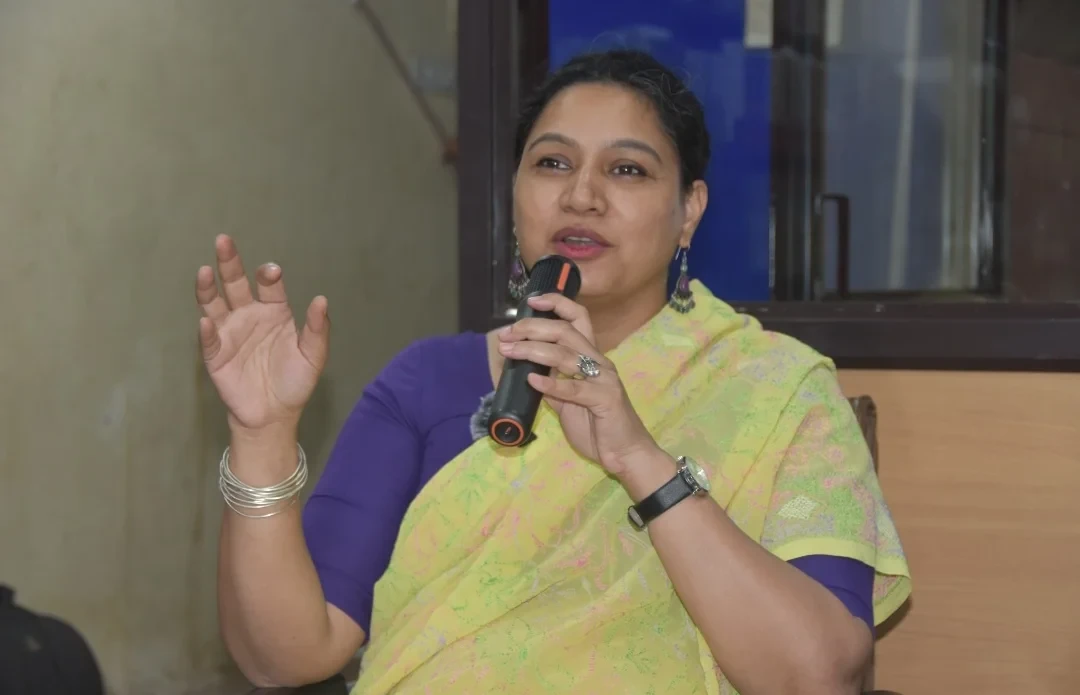
-A discussion was held on Monday evening at the Rajkamal Prakashan office on Ashok Rajpath regarding the internationally acclaimed book ‘Koi Ek Saida’ (A Certain Saida), authored by journalist Neha Dixit. In conversation with fellow journalist Pushyamitra, Neha Dixit remarked, "I had been consistently reporting on various issues concerning women, but those efforts weren't yielding any significant breakthrough. When I met Saida, I realized that her story encompassed multiple, intersecting issues: she is a female laborer—specifically a piece-rate worker—and a victim of communalism. She works 12 hours a day, yet she does not even identify herself as a 'laborer'."

DISCUSSION ON NEHA DIXIT’S BOOK ‘KOI EK SAIDA
29-OCT-ENG 2


RAJIV NAYAN AGRAWAL
PATNA--------------------------A discussion was held on Monday evening at the Rajkamal Prakashan office on Ashok Rajpath regarding the internationally acclaimed book ‘Koi Ek Saida’ (A Certain Saida), authored by journalist Neha Dixit. In conversation with fellow journalist Pushyamitra, Neha Dixit remarked, "I had been consistently reporting on various issues concerning women, but those efforts weren't yielding any significant breakthrough. When I met Saida, I realized that her story encompassed multiple, intersecting issues: she is a female laborer—specifically a piece-rate worker—and a victim of communalism. She works 12 hours a day, yet she does not even identify herself as a 'laborer'."
She added, "Throughout her life, Saida has held over 50 different types of jobs, yet none provided enough income to help her overcome the struggle to meet basic living expenses. While living in a Delhi slum, Saida and her family not only faced crises related to employment and wages but also fell victim to communalism. At one point, she participated in a strike, through which she and her fellow workers managed to secure their rights—a strike by piece-rate workers that, notably, never caught the attention of the media."
The story of Reshma—Saida’s daughter’s generation—reveals a different, more insidious form of exploitation. Seeking a better life, she takes a job cleaning restrooms in a shopping mall, only to encounter a modern, evolved form of 'untouchability.' She is barred from using the very restrooms she cleans, and she must hide to eat her lunch. She is forced to lead a deeply uncomfortable and dehumanizing existence.
Dixit emphasized that for a journalist, the ability to ask questions, rigorously verify facts, maintain a constant desire to learn, and engage with diverse sections of society to truly grasp the underlying realities is absolutely essential. Rather than viewing journalism merely as a job or a career, it should serve as a means to understand society and bring issues of public interest to the forefront.
During a discussion, Pushyamitra remarked that this is an epic account of the life of a female 'piece-rate' worker—a struggle further compounded by her status as a member of a minority community. The book reveals layers of labor and wage structures that often remain hidden from our view. It is a common assumption that men are the primary breadwinners in a household, while women work merely for 'pocket money.' However, this book illustrates that in metropolitan life, women have increasingly become the primary earners, sustaining their households. Men, meanwhile, have shifted to part-time, often irresponsible roles, frequently squandering a large portion of their earnings on substance abuse. The book also sheds light on the subtle, modern forms of 'untouchability'—a reality starkly highlighted when Saeeda’s daughter seeks employment at a shopping mall.
Neha Dixit’s book, *Many Lives of Syeda X*—originally published in English—has been translated into Hindi by the noted translator Prabhat Singh.
The book is a poignant chronicle of the three-decade-long struggle of a migrant woman who arrived in Delhi after enduring the trauma of communal violence and displacement. Through the story of this woman—who undertook over fifty different, arduous jobs to secure her livelihood and dignity—the author brings to light the economic exploitation, invisible labor, and indomitable courage of marginalized female workers. Furthermore, by addressing the labor and rights of the millions of women working within India’s informal sector, the book exposes how large cities—which rely heavily on the toil of migrant workers—consistently fail to provide them with security, respect, or basic human rights.
What's Your Reaction?
 Like
0
 Dislike
0
 Love
0
 Funny
0
 Wow
0
 Sad
0
 Angry
0







Comments (0)